As one of the most popular and straightforward casino games, roulette is often considered easy even for novices. However, to win consistently, players need a deep understanding of its rules, which have evolved over the last few centuries.
Since roulette was first introduced in France in the late 18th century, it has spread to every casino and gambling establishment in the world. Historians believe that it was devised by French mathematician and inventor Blaise Pascal in an attempt to create a perpetual motion machine. In this primitive form, the game was quite different from what we know today. Still, it managed to become the most easily recognized casino game in the world.
Much of its popularity can be attributed to its simplicity and to the fact that the outcome of each spin is based purely on chance. Players do not need any particular skill or complex strategies to win; they simply pick a number, place a bet, and hope that luck is on their side. However, knowing the rules can significantly increase one’s chances of winning because some bets are better than others.
In this article, we focus on the standard roulette rules that apply to virtually all forms of modern roulette, whether we play in a brick-and-mortar casino or prefer the virtual version found in online casinos.
Roulette Basics
In land-based casinos, roulette is played on a large wooden table, and the seats around it are reserved for players only. A casino employee, known as a croupier, announces the winning numbers, collects wagers, and pays out winnings. In the traditional version of the game, the croupier tosses a small ball onto a spinning wheel with colored pockets numbered 0 through 36; note that American roulette has an additional pocket for 00 (double zero).
Once the wheel stops, the croupier calls out the number of the pocket in which the ball has landed. Anyone who placed a bet on that number, or on its corresponding color or category, receives a fixed payout determined by the rules. Bets are placed with casino chips that represent different amounts of money ($1, $5, $10, $50, and so on) while the wheel is still spinning. When it stops, or when the croupier announces “No more bets,” all wagers on the table are final and cannot be moved or removed.
This brings us to another essential part of the game, the table layout. The gaming table is covered with a green felt cloth (although it can also be blue, red, or purple) that features a chart with all the numbers from the wheel. This is a simple rectangular diagram that shows all possible bets and their respective payouts, and chips are placed on top of it. As you can see, the rules are quite straightforward, and it usually takes only a few spins before they become second nature. There are, however, a few details players should note, including the different types of wheels and table layouts.

Roulette Wheels

Roulette Table Layout
Roulette Wheels
The roulette wheel is composed of two main parts: an outer section called the bowl and an inner section known as the wheelhead. Depending on the type and build quality of the gaming table, the construction may vary, but the bowl usually includes the ball track, lower back track, spindle, and canoe stops. The lower track is where the ball rolls, and on it you can see small diamond-shaped deflectors (also called disruptors, diamonds, or canoe stops) that cause the ball to bounce and move unpredictably.
The inner part contains the numbered pockets along with the rotor, the wheel’s main moving component, and the central turret. There are many more mechanical parts, of course, but players usually focus on the pocket section. It holds black, red, and green pockets numbered as follows: 37 pockets in European and French-style games and 38 pockets in American-style roulette. The numbers appear random, yet half are red and half are black. The single- and double-zero pockets are green.
- European/French roulette wheel: 18 red, 18 black, and one green pocket for 0
- American roulette wheel: 18 red, 18 black, and two green pockets for 0 and 00
Players will quickly notice that the numbers are not arranged in numerical order; instead, red and black pockets alternate throughout the wheel. Whether you play American or European roulette, you will not find two adjacent pockets with the same color. Low (1–18) and high (19–36) numbers also alternate as much as possible, and even and odd numbers are spread out evenly. The sequence is therefore carefully planned to make the wheel balanced and to appear random:
- European/French wheel number sequence: 0, 32, 15, 19, 4, 21, 2, 25, 17, 34, 6, 27, 13, 36, 11, 30, 8, 23, 10, 5, 24, 16, 33, 1, 20, 14, 31, 9, 22, 18, 29, 7, 28, 12, 35, 3, 26
- American wheel number sequence: 0, 28, 9, 26, 30, 11, 7, 20, 32, 17, 5, 22, 34, 15, 3, 24, 36, 13, 1, 00, 27, 10, 25, 29, 12, 8, 19, 31, 18, 6, 21, 33, 16, 4, 23, 35, 14, 2
These sequences may look confusing, but players do not need to memorize them; they simply need to understand why low/high, red/black, and even/odd numbers are distributed as evenly as possible across the wheel. Interestingly, the sum of all numbers is exactly 666, which once earned roulette the nickname “the devil’s game.” This is just one of many curiosities that make roulette so appealing to players.
Roulette Table Layout
As mentioned above, alongside the wheel, the table layout is the other fundamental element of roulette. Also called the betting layout or simply the layout, it displays all numbers from the wheel (0–36). It is deliberately designed to differ from the wheel’s arrangement. On the layout, the numbers appear in consecutive order, whereas on the wheel they seem random, even though, as we have shown, they are carefully arranged.
The main section of the layout is a rectangular numbered grid with three columns and twelve rows that hold the numbers 1 through 36. The 0 and 00 sit at the top of this grid. At the bottom, three squares lie beneath the three columns. Several betting areas sit beside the grid; here you will find spaces for low and high numbers, red and black numbers, and odd and even numbers. In addition, there are three areas for the first (1–12), second (13–24), and third (25–36) dozens.
Many players structure their bets according to this layout. For example, they might wager on 1 and 2 because these numbers are adjacent on the grid, even though they sit on opposite sides of the wheel. While this difference does not matter when playing virtual roulette in an online casino, it can influence betting strategy in a physical game.
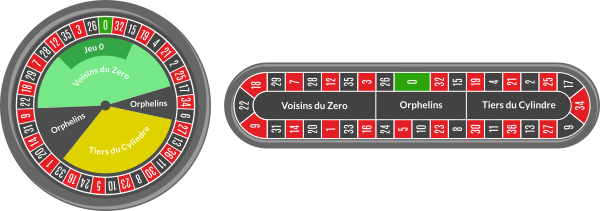
Players who prefer to base their bets on the wheel’s number arrangement can use the racetrack layout. This addition to the main layout is not present in every variation of roulette. Named for its oval, stadium-like shape, the racetrack is a graphic representation of the wheel’s sequence, allowing players to bet on actual wheel sections rather than on numbers that are distant from each other on the wheel.
Like the main betting layout, the racetrack is divided into several sections, each tied to a specific type of bet. These include the Voisins du zéro, Le tiers du cylindre, Jeu zéro, and Orphelins, four bets commonly found in French or European roulette. We will discuss them in one of the following sections of this article.
Object and Rules of the Game
 The object of the game is simple and straightforward: to predict correctly where the ball will land after the wheel stops turning. As you can imagine, this is easier said than done, especially when we play virtual roulette. In contrast, when playing the physical game, professional gamblers can spot irregularities in the wheel caused by wear and tear. From these observations, they can determine whether the wheel is biased and if certain sections or numbers are more likely to be hit.
When it comes to virtual roulette, however, the outcome of every spin is random and cannot be predicted, a fact guaranteed by a special piece of software called a Random Number Generator (RNG). Once players place their chips on the table, they press the Spin button and the computer determines the winning number. The outcome is not influenced by past or future spins: each time, players face one winning number and 36 losing numbers (or 37 losing numbers in American double-zero roulette).
If players correctly guess the winning number or a group of numbers, they win and receive a payout that is a multiple of their original stake. Each type of bet has a different payout, but the general rule is that bets more likely to win come with lower payouts. The less likely the outcome, the higher the potential reward.
For instance, the Red sector on the betting layout pays even money at 1 to 1, sometimes displayed as 1:1 or even 2:1 because we receive our original bet plus one unit. This bet is more likely to win since there are 18 red numbers on the wheel. The chance of hitting the number 5 is much lower (1 out of 37), so the payout is a far more attractive 35:1.
Bets and Payouts
Betting is one of the most important aspects of roulette, and the reason is simple: choosing the right type of bet can improve your chances of winning. As shown above, some wagers have a higher probability of success than others. For this reason, players should learn the basic bet types before playing roulette for real money.
Many roulette fans also combine several bets to cover more of the layout. Even the finest betting strategy, however, cannot alter the game’s inherent odds, so it is impossible to gain an advantage over the casino. Still, understanding each bet and its payout is essential for judging the value of a wager and its expected return.

Outside Bets

Inside Bets
Called Bets
Outside Bets
Outside bets are among the most popular wagers because they involve lower risk. They offer better odds of winning, but their payouts are relatively small. To make any of these bets, players place their chips in the areas outside the main numbered grid, hence the term “outside” bets.
Although these wagers cover large groups of numbers, they all lose if the ball lands on 0 or 00. The zeros are neither red nor black, neither low nor high, and neither even nor odd, and they do not belong to any of the three dozens or three columns. For this reason, they are called casino numbers, the pockets that give the house its edge.
- Red/Black: Each selection covers 18 numbers and pays 1:1.
- Low/High: Again, 18 low numbers (1–18) and 18 high numbers (19–36) pay 1:1.
- Even/Odd: Bet on all even (2, 4, 6…) or all odd (1, 3, 5…) numbers. Each option covers 18 numbers and pays 1:1.
- Dozens: Players can bet on the first (1–12), second (13–24), or third (25–36) dozen. Each pays 2:1.
- Columns: Three betting areas cover the three columns on the layout. Each bet pays 2:1.
Inside Bets
Inside bets are wagers placed within the numbered grid. They cover fewer numbers, so their odds of winning are lower, but their payouts are higher. Unlike outside bets, where chips are placed in designated squares, inside bets often require chips to be positioned on the borders of two or more betting areas.
- Straight: A bet on a single number that pays 35:1.
- Split: A wager on two adjacent numbers on the grid, such as 1 and 2 or 1 and 4. It pays 17:1.
- Street: Covers any three numbers in a row and pays 11:1.
- Square (Corner): Covers any four neighboring numbers that form a square. It pays 8:1.
- Six Line (Double Street): Also called the double street; it covers two adjacent streets for a total of six numbers and pays 5:1.
- Top Line (Basket): Involves the first four or five numbers, depending on the game. In single-zero roulette it covers 0-1-2-3 and pays 8:1, while in double-zero versions it covers 0-00-1-2-3 and pays 6:1.
Called Bets
The other category of wagers is known as Called or Announced Bets. Although the two terms differ technically, they are used interchangeably in online roulette and in many land-based casinos. These wagers are often called French bets because their names are displayed in French and they are typical of European and French-style roulette. Many virtual American roulette games also allow Announced Bets.
Unlike standard inside and outside bets, Called Bets are placed on the racetrack rather than on the main layout. They let players wager on wheel sections instead of on numbers that follow numerical order. Because a single Called Bet can cover many numbers, players can increase their chances of winning without staking too much.
This overview focuses on Announced Bets in single-zero roulette. In American roulette, both the bets and their payouts differ. Another rule applies to the minimum stake: players usually need to place at least three or four chips to make these wagers. Remember that Called Bets are combinations, and the casino pays only for the portion of the bet that wins, not for the entire combination.
- Voisins du zéro: Translates to “neighbors of zero” and covers the 17 numbers surrounding zero, including zero itself. The minimum wager is nine chips: two chips on 0-2-3, one chip on each of the splits 4-7, 12-15, 18-21, 19-22, and 32-35, and two chips on the corner 25-26-28-29.
- Le tiers du cylindre: Means “one-third of the wheel” and covers the sector opposite the Voisins. It includes 12 numbers and requires six chips on 27-13-36-11-30-8-23-10-5-24-16-33.
- Orphelins: Translates to “the orphans” and covers the two small sectors not included in the Voisins and Tiers bets. It covers eight numbers and is placed with five chips: one straight-up chip on 1 and one chip on each of the splits 6-9, 14-17, 17-20, and 31-34.
- Jeu zéro: The “zero game” is a bet on five numbers: the 0 and the four numbers adjacent to it on the wheel. It covers 12-35-3-26-0-32-15 and requires four chips.
- Final Bets: These wagers target numbers sharing the same final digit. For example, final 0 is a four-chip bet on 0-10-20-30, while final 1 is a four-chip bet on 1-11-21-31. Some casinos offer two kinds of finals: Finales en Plein and Finales à Cheval, the latter combining two final digits. Finales à Cheval on 7 and 8, for instance, is a bet on 7-8-17-18-27-28.
- Neighbors: A five-chip bet on any given number plus the two numbers on each side of it, such as 19 and its neighbors 4, 15, 21, and 32.
Betting Limits
 Before starting a real-money game, casino patrons should always take the betting limits into account. Depending on the type of casino, the roulette variation, and sometimes even the player’s VIP status, the minimum and maximum stakes will differ. This is crucial because players with a bankroll of $100 would not be able to play more than a few spins if the table minimum is $50. It is generally recommended to bet no more than 1%-2% of your bankroll on a single round, so players with a $100 bankroll should not wager more than $2 per spin.
Many online casinos offer minimum stakes of $1, but the limits vary from one casino to another. There are also low-limit tables with bets from $1 to $10 per spin and high-limit tables with stakes from $50 to $500 per spin. Most casinos use a progressive model to determine the maximum amount allowed for each bet type. If, for example, the casino accepts straight bets up to $250, the maximum stake on splits would be $500 (2x). The maximum bet allowed on a street would be $750 (3x); on a corner bet, $1,000 (4x); on a six line, $1,500 (6x); on dozens and columns, $1,750 (7x); and on low/high, even/odd, and red/black, $2,000 (8x).
Additional Roulette Rules
Several additional rules appear in certain roulette variations. Three of them, Surrender, En Prison, and La Partage, apply specifically when 0 or 00 wins. These rules are not always offered by casinos, and they are particularly rare in online roulette. Because they reduce the house edge, however, they are popular with professional and advantage players.
| Imprisonment Variation | Probabilities of Winning | Probabilities of Losing | Probabilities of Push | Expected Value |
| Single Imprisonment | 0.48648649 | 0.50036523 | 0.01314828 | -0.01387874 |
| Double Imprisonment | 0.48648649 | 0.50019005 | 0.01332346 | -0.01370356 |
| Triple Imprisonment | 0.48648649 | 0.50018768 | 0.01332583 | -0.0137012 |

Surrender

“La Partage” Rule

“En Prison” Rule
Surrender
The Surrender rule appears in some American-style roulette games and triggers when the ball lands on 0 or 00. Players who have placed “even-money” outside bets (red/black, low/high, even/odd) lose only half of their stake. This rule reduces the casino’s house edge from 5.26% to 2.63%.
“La Partage” Rule
La Partage is nearly identical to Surrender, but it applies to European roulette, particularly in many UK casinos. The rule triggers automatically when the ball lands on 0 and reduces the house edge from 2.70% to 1.35% for all even-money outside bets.
“En Prison” Rule
En Prison is a variation of La Partage and appears in some French-style roulette games. The rule applies when a player has placed an even-money bet and the ball lands on 0. The player then has two choices: surrender half of the bet, as in the rules above, or leave the entire wager “in prison” for the next spin.
With the second option, the chips stay on the same square. If the bet wins on the next spin, the player collects the winnings. If it loses, the entire amount goes to the casino. Games that use the En Prison rule also carry a lower house edge of 1.35%.