


The Fibonacci Casino Strategy is considered one of the most complex and interesting betting systems ever created, mainly because it is based on an almost mysterious sequence of numbers that can be found in various aspects of science, art, and nature. When used in gambling, the sequence creates an aggressive yet relatively safe negative progression that increases the bet amount after each loss.
Interestingly, Fibonacci numbers seem to exist all around us, in music, nature, and mathematics, and they can be applied to many areas of life. Those who have not heard of them before might be surprised by how simple the sequence is: each number equals the sum of the previous two numbers. It may start with zero, but some variations omit it, and the sequence then begins with 1, 1, 2, 3, 5, 8, 13, and is theoretically endless.
The sequence was named after a medieval Italian mathematician from the Republic of Pisa who used it to calculate the theoretical growth of rabbit populations. However, Leonardo of Pisa, later known as Fibonacci, was not the creator of this intriguing line of numbers; he only introduced it to the West in 1202 in his groundbreaking book Liber Abaci. The sequence was first discovered and described by Indian mathematicians centuries earlier.
Today, Fibonacci numbers are used in mathematics, computer programming, data analysis, optics, economics, music, and art. Interestingly, they can also be observed in biological settings such as the branching of trees and the arrangement of leaves and flowers on the stem. Gamblers have apparently recognized the appeal of this pattern and applied it to their betting strategies in games where two possible outcomes have almost a 50% chance of occurring. Most commonly used in roulette, the Fibonacci Strategy allows casino players to structure their bets so that they can turn a profit even if they lose several spins in a row.
How It Works
The Fibonacci betting system works in a very simple, straightforward manner and can be used even by players who are not particularly familiar with betting strategies. As we have already established, the strategy is based on the famous Fibonacci sequence, where each number in the sequence is formed by adding the previous two.
The Concept
 Although scientists today start the Fibonacci sequence with zero, this is not really relevant to the size of the bets, so the casino system starts with 1. To continue the pattern, we need another 1 and then we get 2 (1+1), 3 (2+1), 5 (3+2), and so on. These are the first Fibonacci numbers and the ones usually used in betting:
1, 1, 2, 3, 5, 8, 13, 21, 34, 55, 89, 144, 233, 377, 610, etc.
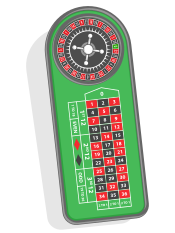
The strategy based on these numbers is applied to even-money bets in roulette, namely red and black, high and low, and even and odd. As you know, red and black are equally likely to occur in the game, but the exact odds are slightly below 50% because of the green zero on the roulette wheel. Still, these even-money bets are as close as you can get to 50/50 chances in this casino game. In European or French roulette, each of these bets gives us 18 ways to win and 19 ways to lose. For this reason, picking one of them and sticking to it throughout the betting session is recommended when using the Fibonacci betting system.
Using the Fibonacci Sequence in Roulette
 So, how do the numbers in the sequence relate to the wagers in the game? Each number represents the number of units we bet on the following spin. The unit may be of any monetary value as long as it is above the table minimum, and land-based casinos usually accept bets from $5-$10 up to $1,000 or even more per spin. The limits are much lower in online casinos, however, and in virtual roulette each spin can cost between $1 and $500. If the chosen unit is $5, the bets in the sequence will be $5 – $5 – $10 – $15 – $25 – $40 – $65 – $105 – $170, and so on. One good piece of advice is to limit the bet amount to a maximum of 5% of the player’s entire bankroll.
These bets are placed only in certain circumstances. Because the Fibonacci strategy is a negative progression, it requires players to increase their bets after a losing spin. Therefore, the bets follow the sequence as long as they lose. Once a bet wins, however, players go back two steps in the sequence. For example, if we place a $5 chip on black and lose, we keep the $5 wager for the next spin, and if it loses too, we increase the bet to 2 units, or $10. If the ball lands on red once again, our wager for the next spin is $15. In case this bet wins, we move back two numbers in the sequence and, for our next bet, we place a single-unit wager ($5).
Here is an example of a betting session that uses the Fibonacci strategy.
| Spin | Bet | Outcome | Payout | Profit |
|---|---|---|---|---|
| 1 | $5 | Lose | $0 | -$5 |
| 2 | $5 | Lose | $0 | -$10 |
| 3 | $10 | Lose | $0 | -$20 |
| 4 | $15 | Lose | $0 | -$35 |
| 5 | $25 | Lose | $0 | -$60 |
| 6 | $40 | Win | $80 | -$20 |
| 7 | $15 | Win | $30 | -$5 |
| 8 | $5 | Lose | $0 | -$10 |
| 9 | $10 | Win | $20 | $0 |
| 10 | $5 | Win | $10 | $5 |
| Total Bet Amount: | $135 | Total Payout: | $140 | Net Profit: $5 |
One of the most important things about this system is that if a win is registered after two losing bets, its payout will balance out the losses. For example, if our first two $5 bets lose and we are $10 in the red, but the next wager, which is also $10, wins, our net profit will be $0. Unlike some other betting systems, a single winning bet here cannot compensate for more than two consecutive losses.
Fibonacci Roulette Strategy Gameplay
The Reverse Fibonacci Strategy
 Most betting systems used for roulette have variations that are complete opposites of the originals. The Fibonacci system is no exception, and the Reverse Fibonacci is almost as popular as the classic strategy. The two progressions are identical, but while the original is a negative progression, its reverse counterpart is positive.
This means that the bets are increased, following the Fibonacci sequence, after winning spins. If a bet loses, players should go back two numbers in the sequence, effectively cutting the stake amount for the following spin. It is obvious that with this method turning a profit requires more wins than losses, which relies on pure chance and is therefore not a particularly reliable strategy.
If we start the sequence with $5, for example, and win twice in a row, we will have $10 in winnings. Our next wager must be $10, and if we lose it, the entire profit from the previous two bets is gone. If the third bet had won, however, our net profit would have increased to $20. Following the Fibonacci system, we would then place a $15 wager, and even if this one lost, we would still be $5 ahead.
| Spin | Bet | Outcome | Payout | Profit |
|---|---|---|---|---|
| 1 | $5 | Win | $10 | $5 |
| 2 | $5 | Win | $10 | $10 |
| 3 | $10 | Win | $20 | $20 |
| 4 | $15 | Lose | $0 | $5 |
| Total Bet Amount: | $35 | Total Payout: | $40 | Net Profit: $5 |
It is evident that the Reverse Fibonacci enables casino players to take advantage of longer winning streaks. They can still turn a profit after a losing bet as long as they have won three or more consecutive bets beforehand. If several losses occur in a row, especially at the beginning of the progression, players will need to start the sequence over and will find it hard to regain the money they have already lost.
Things to Consider when Using the Fibonacci System
 No betting system is perfect, and the Fibonacci is no exception, so before deciding to use it to play roulette, players should consider several important aspects. First, it is essential to understand how and when the progression stops. Unlike other systems that can seemingly go on indefinitely or until the player decides to quit, the Fibonacci sequence can easily come to an end after just a few winning bets (or a few losing ones in the reverse variation). This happens because of the rule that requires moving back two steps in the sequence each time we win (or lose if we use the Reverse Fibonacci).
Another thing to take into account when applying this system is the potential for huge losses and the need to prevent them. Roulette players know that long losing streaks are real, just as long winning ones are, and because the bet increases at a very steep rate in the Fibonacci system, there is a risk of losing one’s entire bankroll with 7-8 or even more consecutive losses. This is why players should set a limit in their progression and minimize losses whenever possible.
Many experienced gamblers recommend playing no more than 6 or 7 steps of the Fibonacci sequence. The sixth number in the pattern is 8 and the seventh is 13. If the initial wager is $1, even 10 consecutive losses would not cause much trouble. If we choose $5 as the basic betting unit, however, and experience a long losing streak, we would lose $270 in 8 spins, $440 in 9 spins, and $715 in 10 losing spins. For this reason, most players tend to stop the progression if they lose more than six bets in a row.
Advantages and Disadvantages of the Fibonacci Casino Strategy
 The Fibonacci numbers are an interesting group and are certainly worth exploring in mathematics or the natural sciences. For gambling, however, they may not be as useful as some casino players hope. The betting system based on these otherwise universal numbers has both benefits and drawbacks that must be carefully weighed against each other.
Compared with most betting strategies, the Fibonacci method is very aggressive; each subsequent bet rises quickly and could lead to devastating losses. At the same time, the system can be relatively safe and reliable if used with low stakes and for short periods. In the long run, it will inevitably result in a net loss because the game of roulette is inherently favorable to the casino, not the players. As long as players limit their play to a maximum of seven or eight steps in the sequence, they should be able to generate decent winnings and minimize losses.
Despite appearing complicated at first glance, the Fibonacci system is quite simple to understand and easy to follow. Usually, players remember the first 10 or 15 numbers of the sequence; 15 steps are too many for most gamblers, though. It is also easy to calculate each subsequent number as long as you remain within the first 10 steps or so. The higher you progress through the Fibonacci ladder, the larger your bets will grow and the greater your losses can be.
Fibonacci Casino Strategy Additional TipsThe rapidly increasing loss of money is probably the biggest disadvantage of this system. Moreover, as you lose more and more, your bets jump quickly and you could easily reach the table limit without having a chance to recoup your losses. A good solution to this problem is to set a stopping point for your Fibonacci progression, such as the sixth or seventh step of the pattern, or even the fifth.
Conclusion
 Many players are interested in the Fibonacci betting system as a way to structure their bets and increase the value of their play. Indeed, the strategy can be very successful in certain circumstances, but it can be devastating in others. Its basic concept, that two losing bets followed by a winning one will even each other out, is effective at least in theory, but real roulette sessions rarely consist of identical series of two losses and one win.
For this reason, the Fibonacci strategy should be applied with caution and only by players whose disposition and bankroll can tolerate medium risk. Overall, this is a good system for those who have already tried simpler money-management methods and are now searching for a more exciting strategy with the potential to bring them decent winnings over time.