
The abundance of betting systems and casino strategies in recent years has become overwhelming, especially for roulette players who are constantly searching for the perfect strategy, a wildly speculative concept that has been refuted by experts on multiple occasions. Still, that does not mean that all systems and methods are useless. In fact, the Shotwell strategy is considered to be one of the most effective methods for winning in roulette.
Two main factors contribute to the success of this strategy, namely the relatively wide coverage of the wheel and the high payouts. In contrast to popular systems such as the Martingale, the Shotwell strategy does not involve increasing or decreasing the size of the stakes for every spin. Indeed, it is not a betting progression but, rather, a combination of bets that provides players with one in four chances of winning. In fact, this strategy covers approximately 26% of the roulette wheel.
So, what is the Shotwell and how is it used? The strategy was first published in Gambling Times Magazine in 1978 and was originally designed for the American version of the game, which is played with 38 numbers: 36 red and black numbers and two green sectors on the wheel for 0 and 00. Today, it is used on both single and double-zero roulette variations, and unlike most of the other strategies and combination bets that focus on the betting layout, it pays attention to the wheel.
Players who use this strategy can choose from seven different options, each consisting of one six-line bet and four straight-up bets. The idea is to play with numbers that are more or less evenly distributed on the wheel. When the Shotwell was first introduced, experts promised players that every winning number would be in close proximity to their numbers. You should not worry if that makes no sense to you. The proximity of the winning numbers to your numbers is completely irrelevant to the efficiency of the strategy.
How It Works
 Despite its seemingly complex structure, the Shotwell works quite simply. It represents a combination of two wagers: straights and six-lines. To use this interesting method, players choose one of the seven possible six-line bets on the layout. This is a bet that covers six consecutive numbers and is also known as a double street, as it contains two street bets, i.e. two rows of numbers. Then, they complete the strategy with four bets on single numbers, a wager called a straight-up bet.
But the four straight-up bets are not randomly picked. They should be evenly distributed on the wheel between the numbers already chosen in the six-line. The main idea is to pick the bets that would leave no more than 3 pockets between your chosen numbers. This is quite an interesting aspect of the strategy: every time the ball lands on one lucky number, players see that it is very close to one of their numbers.
This makes the Shotwell extremely exciting, even though the proximity of the numbers has no impact on efficiency or profitability. What makes the strategy potentially profitable is the payout offered whenever the players’ chosen combination wins. The six-line bet pays 5:1, while the straight-up bet pays 35:1, which is the highest reward offered in the game. Players bet on a total of ten numbers on each spin, which is approximately 26.30% of all numbers in double-zero American roulette.
Note that this strategy is best used with this version of the game even though the odds here are worse. It is simply harder to distribute the numbers evenly in the single-zero European and French roulette variations.
Shotwell Roulette Strategy Gameplay
Using the Shotwell Strategy in American Roulette
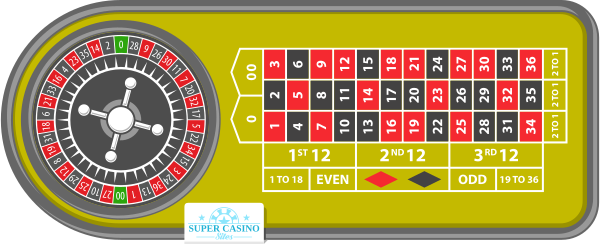 As mentioned above, this strategy was originally intended for the American type of roulette, where the number of pockets on the wheel is even. Therefore, you can easily pick your numbers in an order that places them at equal distances from each other. When applying the strategy, players first need to choose a preferred six-line bet and place a one-chip bet on the corner shared by the two rightmost or leftmost numbers.
Typically, there are 10 possible six-line bets that can be placed on the layout, but not all offer the same even distribution of numbers on the wheel. The payout for this bet is 5 to 1, or 5:1, as it is usually displayed. When this bet wins, the casino pays six chips, which include the original one-chip bet plus a profit of five chips. The next step is choosing the four straight-up numbers and placing one-chip bets on them. As mentioned above, the payout here is 35:1. In total, players wager five chips on every spin and when they win, they receive either 6 or 36 chips as a payout. Below, you can see the seven options for American roulette:
- Six-line: 1 through 6 | Straight-ups: 20, 26, 8, 10
- Six-line: 4 through 9 | Straight-ups: 13, 14, 15, 10
- Six-line: 10 through 15 | Straight-ups: 16, 17, 18, 28
- Six-line: 13 through 18 | Straight-ups: 11, 12, 27, 28
- Six-line: 19 through 24 | Straight-ups: 1, 2, 4, 26
- Six-line: 28 through 33 | Straight-ups: 00, 22, 24, 35
- Six-line: 31 through 36 | Straight-ups: 0, 00, 29, 30
Using the Shotwell Strategy in French/European Roulette
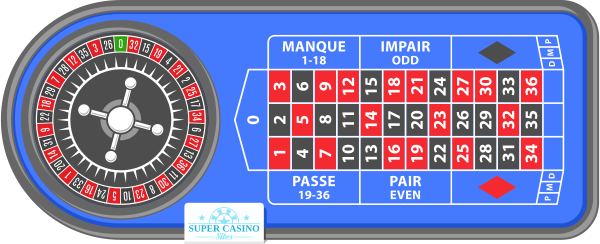 The strategy is, of course, applicable to single-zero roulette games as well. In fact, the French/European roulette version is always recommended due to its house edge, which is almost half that of American roulette (5.26%). However, due to the different arrangement of numbers here and the fact that there are 37 pockets on the wheel, the distribution of the numbers will not be even.
We will not specify all numbers that can be paired with each six-line bet as this is up to players to decide. For a better distribution and balance, you could pick five numbers instead of four. In this case, however, each spin would cost six units, and the wins would be significantly less profitable because the one-chip profit that we get in American roulette would be “eaten up” by the additional straight-up bet. This is an example of the Shotwell strategy in European/French roulette:
Six-line: 1 through 6 | Straight-ups: 15, 27, 30, 9, 7, 36
Applying the Shotwell Strategy
 In order to play responsibly and with the lowest risk possible, players are advised to carefully choose the amount of money they would wager with the Shotwell strategy. As we mentioned above, each bet costs five chips in total, but their value can vary depending on the player’s bankroll and the wagering limits at the table. To simplify the betting process with this system, we will replace the chips with the term “betting unit.” One unit will be the base bet amount, and it could be any amount of money.
So, on each of the four straight-ups, we will bet 1 unit and another 1 unit will be wagered on the six-line. Let’s see how the Shotwell will perform in 10 random spins. For the example below, we are betting 5 units, worth $5, on each spin. We have chosen the first six-line bet, so our wager covers the following numbers: 1, 2, 3, 4, 5, 6, 8, 10, 20, 26.
| Spin | Bet | Outcome | Payout | Profit |
|---|---|---|---|---|
| 1 | $5 | 7, lose | $0 | -$5 |
| 2 | $5 | 29, lose | $0 | -$10 |
| 3 | $5 | 29 | $0 | -$15 |
| 4 | $5 | 24, lose | $0 | -$20 |
| 5 | $5 | 34, lose | $0 | -$25 |
| 6 | $5 | 11, lose | $0 | -$30 |
| 7 | $5 | 19, lose | $0 | -$35 |
| 8 | $5 | 10, win | $36 | -$4 |
| 9 | $5 | 1, win | $6 | -$3 |
| 10 | $5 | 8, win | $36 | $28 |
| Total Bet Amount: $50 | Total Payout: $78 | Net Profit: $28 |
Is the Shotwell Strategy Worth Using?
 Most roulette strategies and casino betting systems cannot guarantee winnings in the long term, and the Shotwell is no exception because it does not eliminate one crucial feature of roulette, namely the house edge. The house edge ensures that casinos have an advantage over their customers because the payouts are slightly lower than the true odds of each bet. Of course, this house edge, approximately 2.70% in single-zero roulette and 5.26% in double-zero versions, is fixed, and no strategy or betting progression can reduce or eliminate it.
To players, this means that their expected losses over time would come close to these percentages. When playing American roulette, for instance, they would lose $5.26 out of every $100 bet on average. However, players could still win big in the short term, and this is where the Shotwell strategy could be quite profitable under the right circumstances. When players win any of the straight-up bets, they receive a payout of 35 times their wager. Usually, this would be enough to compensate for any previous losses.
On the other hand, the strategy does not have sufficient coverage of the table to win the majority of spins. In fact, it wins only one in four spins on average. While this may not sound too bad theoretically, in reality anything can happen, and the bets in the pattern might not win for 15-20 spins or even longer. The 35:1 payout cannot compensate for more than 5 losses in a row and, considering the mere ten numbers we play with, such losing streaks are very likely to occur.
In order for the Shotwell method to be profitable, players need the right circumstances. First of all, players who use this strategy should have a substantial bankroll and play with the minimum stakes allowed at the casino. They should also have patience because it may take a long time before any of the straight bets win. Even if the six-line wager does win a few times, it brings a modest profit of only one betting unit. This is why the Shotwell is widely considered a high-risk strategy suitable for players who are willing to lose large amounts of money before being able to regain their losses.
For most gamblers who are prepared to expose themselves to some reasonable levels of risk, this strategy will not be worth using. The risk with it is simply too high and the potential for losing lots of money quickly is huge. In the example below, we can see the Shotwell method being used in 10 random, not particularly favorable spins. For this example, we are making the same bet.
| Spin | Bet | Outcome | Payout | Profit |
|---|---|---|---|---|
| 1 | $5 | 11, lose | $0 | -$5 |
| 2 | $5 | 30, lose | $0 | -$10 |
| 3 | $5 | 28, lose | $0 | -$15 |
| 4 | $5 | 19, lose | $0 | -$20 |
| 5 | $5 | 5, win | $6 | -$19 |
| 6 | $5 | 29, lose | $0 | -$24 |
| 7 | $5 | 26, win | $36 | $7 |
| 8 | $5 | 4, win | $6 | $8 |
| 9 | $5 | 18, lose | $0 | $3 |
| 10 | $5 | 24, lose | $0 | -$2 |
| Total Bet Amount: $50 | Total Payout: $48 | Net Loss: $2 |
Shotwell Strategy Additional TipsWhen using this wagering strategy, players need to know that they will have more losses than wins. They will occasionally have winning straight-up bets, but most of the time they will lose, as the chance of the ball landing in any of the four straight-ups is only 2.63% in American roulette. The odds are almost the same in European roulette: 2.70%. The probability of winning for the six-line bet is 15.78% in American and 16.21% in European/French roulette.
Advantages and Disadvantages of the Shotwell Strategy
 Playing roulette for many rounds can often be boring and monotonous, especially for those who prefer to play safe with outside bets such as red/black or low/high. Trying out the Shotwell strategy will certainly make the game much more exciting. In addition to its entertainment value, it has one more interesting advantage: it can bring some quite appealing profits if given enough time.
Indeed, the strategy could turn out to be successful for high-rollers and casino players who are willing to take huge risks. Other than that, the Shotwell strategy does not have much else to offer. It is incredibly unpredictable, risky, expensive, and time-consuming. Most of the time, the winnings it generates can hardly compensate for the losses. The fact that the numbers we bet on are evenly distributed across the wheel is not useful at all. In fact, the whole concept of your numbers being close to the winning ones is pointless.
A better strategy would be for players to pick one of the Announced Bets, the Voisins, for example, which covers a large section of the wheel around the zero pocket. In fact, various other combination bets or French bets would be less risky and more profitable. As you can clearly see, the Shotwell system does not guarantee solid, regular winnings and decent profits. Moreover, it does not reduce the house edge of the game, so players will certainly lose in the long run.
Conclusion
 The Shotwell Strategy is a relatively popular system, although it is not particularly effective in providing reliable winnings. Indeed, it comes with various disadvantages, especially compared to other methods, yet it could be quite exciting for roulette players who want to try something different. The Shotwell is bold and risky but quite fun, and it may teach you how to structure your betting rather than placing your chips chaotically on the table.