
Roulette is one of the simplest games in casinos, yet it is also one of the most elegant and exciting games to watch and bet on. What makes it so appealing is the vast choice of bets players can make on the table, where they can pick their lucky number, bet on red or black, or choose any other combination of numbers. The variety of options is immense, and learning how to use them can certainly enrich players’ gaming experience.
Betting is a fundamental aspect of every casino game, but in roulette it plays an especially important role in determining a player’s chances of winning. Not all bets are the same, and not all of them carry the same risk or reward. There are several main types of bets that most people would be quite familiar with, whether they have played roulette before or not. Other bets are known only to seasoned players, while another group of bets can be found in just a small number of casinos.
Before plunging into the types of wagers, their odds and payouts, we should explain in very simple terms how and when bets are placed. Players are allowed to bet once the game has started; they do so by placing chips on a specific part of the roulette table called the layout. The layout is the rectangular numbered grid where all the numbers from the roulette wheel are arranged in consecutive order. Multiple bets can be placed at once, and usually each field on the layout has specific betting limits determined by the casino.
Players can place their chips even after the wheel has started spinning, but betting stops once the croupier announces “No more bets” or the ball lands in one of the pockets on the wheel. Of course, casinos never accept bets made after the ball has settled in one of the numbered pockets. When the ball stops moving, the winning number is announced and the dealer places a win marker. All losing chips are swept away, while winning players receive their payouts.
So, what types of wagers can be made in roulette, and are some bets better than others? That is up to each player to decide, depending on their style of play, bankroll, and temperament.
Basic Roulette Bets
 Players can wager on a single number, as well as on different groups of numbers. The more numbers included in the bet, the greater the odds for winning. However, as the odds increase, the payouts decrease, which keeps the game balanced. Players should know that all bets favor the house, and even the so-called “even bets” are not actually even, as they come with odds of less than fifty-fifty.
The two main categories of bets that can be seen in any type of roulette, physical or virtual, are the “inside” and “outside” bets. The two terms have nothing to do with how numbers are positioned on the wheel; rather, they refer to the main betting layout on the roulette table. When placing an inside bet, players put their chips on the numbered grid within the separate cells corresponding to the 37 or 38 numbers in the typical European/French or American styles of roulette. The outside bets are made by placing the chips outside this main grid, where the fields for columns, dozens, red/black, even/odd, and high/low are located.
It should be noted that the zero or zeros do not fall under the following categories: red or black, high or low, and even or odd, so typically these bets lose if the ball lands on 0 or 00. In some casinos in the United Kingdom, however, players lose only half of their stake in this scenario. Of course, the zeros are in neither column of the grid nor in any dozen.
| Bet | Ways to Win | Payout (Casino Odds) | Odds against Winning (European/French Roulette) | Probability of winning (European/French Roulette) | Odds against Winning (American Roulette) | Probability of Winning (American Roulette) |
|---|---|---|---|---|---|---|
| Straight Bet | 1 | 35:1 | 36:1 | 2.70% | 37:1 | 2.63% |
| Split | 2 | 17:1 | 17.5:1 | 5.40% | 18:1 | 5.26% |
| Street | 3 | 11:1 | 11.33:1 | 8.11% | 11.667:1 | 7.94% |
| Corner | 4 | 8:1 | 8.25:1 | 10.81% | 8.5:1 | 10.52% |
| Basket | 4 | 8:1 | 8.25:1 | 10.81% | 8.5:1 | 10.52% |
| Six Line | 6 | 5:1 | 5.17:1 | 16.21% | 5.33:1 | 15.78% |
| Dozens | 12 | 2:1 | 2.08:1 | 32.43% | 2.16:1 | 31.57% |
| Columns | 12 | 2:1 | 2.08:1 | 32.43% | 2.16:1 | 31.57% |
| Red/Black | 18 | 1:1 | 1.05:1 | 48.65% | 1.11:1 | 47.37% |
| High/Low | 18 | 1:1 | 1.05:1 | 48.65% | 1.11:1 | 47.37% |
| Even/Odd | 18 | 1:1 | 1.05:1 | 48.65% | 1.11:1 | 47.37% |
Inside Bets

- Straight: This is a bet on a single number, and to make it, players place their chips within the square that corresponds to their chosen number. The straight (or straight bet) pays out 35 to 1.
- Split: A split is a bet on two adjacent numbers on the grid (horizontally or vertically), and its payout is 17 to 1. Chips are placed on the line between the two squares.
- Street: This is a bet on any row of the numbered grid, or in other words, on any three consecutive numbers on a horizontal line. To place this bet, players put their chips on the outer line on either side of the row. The winning street bet pays out 11 to 1.
- Corner: Also known as a square bet, the corner covers four adjoining numbers that form a square. The chips are put on the common corner of these numbers, and if the bet wins, it pays 8 to 1.
- Basket: This bet is known by many names, including base bet, basket, and sucker bet, and is offered only in certain games. In single-zero roulette games, French or European, it covers the first four numbers on the grid, i.e., 0, 1, 2, and 3, and has an 8 to 1 payout. More often found in American-style roulette, it encompasses the two zero fields, 0 and 00, as well as 1, 2, and 3. In this game, it pays 6 to 1. The chip for this bet is placed on the corner shared by the zero (zeros) and 1 or 3.
- Six Line: Also known as double street, this bet covers six consecutive numbers that form two rows. Players make this bet with chips on the corner shared by the two rightmost or leftmost numbers. The payout is 5 to 1.
Outside Bets

- Colors: Players can bet on either all red numbers or all black numbers with this bet. It includes 18 numbers, and the chips are placed in the red and black squares on the layout. The payout is even, i.e., 1 to 1.
- High/Low: This bet also covers nearly half of the numbers on the wheel, 18 to be exact; players wager that the winning number will fall in the low (1-18) or high (19-36) range. Once again, the bet is made with chips within the high/low squares, and the payout is 1 to 1.
- Even/Odd: With this bet, players wager on either all even numbers (2, 4, 6, etc.) or all odd numbers (1, 3, 5, etc.) by putting their chips within the corresponding fields on the layout. Just like the rest of the outside bets, this bet does not include 0 or 00. If it wins, it pays evenly.
- Dozens: Players can also bet that the winning number will be in the first, second, or third dozen by placing chips in the respective fields – 1-12, 13-24, or 25-36. The payout is 2 to 1.
- Columns: On the opposite side of the zero fields on the numbered grid, we can see three squares for the first, second, and third columns of this grid. Players bet on one of these columns by placing their chips in their chosen square. If they win, they receive a payout of 2 to 1.
- Snake Bet: This bet is offered only in some land-based casinos, and its name comes from the snake-like line of numbers players wager on. The bet includes 1, 5, 9, 12, 14, 16, 19, 23, 27, 30, 32, and 34. These are 12 numbers, all red, and the payout for a winning snake bet is 2 to 1.
Racetrack and Call Bets
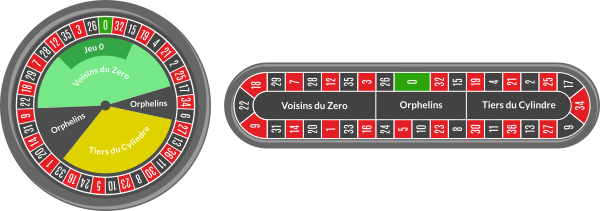
 Some roulette tables, usually the so-called French and European roulette types, have an additional betting section called a racetrack due to its elliptical shape. Unlike the main betting grid, where the numbers are positioned in consecutive order, here they appear in the same order they are on the roulette wheel. This gives players the opportunity to bet on certain sections of the wheel, which is especially popular in land-based casinos where players hope to exploit the natural wear and tear of physical roulette wheels.
This is often referred to as “advantage play”, and some players believe they have gained an advantage over the casino by noticing that the ball tends to land more often on certain numbers or groups of numbers. Of course, today wheels are manufactured much more finely and are monitored by casino staff, so this advantage play is nearly impossible. Still, for those who wish to try such strategies, the racetrack is a better option.
Racetrack and Call Bets Additional TipsMoreover, by betting on large sections of the wheel, players increase their statistical odds of winning. This is a much more realistic and reliable reason to place your chips on the racetrack rather than on the standard grid. The bets available on the racetrack layout are usually called French bets, although this is not entirely true, as some of them are offered in German casinos. Still, their names are often displayed in French. A much more accurate term is “announced bets” or “call bets.” In land-based casinos, players call or announce their bets, and either place their chips on the racetrack or have the croupier do it for them.
Voisins du Zéro (Neighbors of Zero)
This bet covers a large section of the wheel, and its name translates as “neighbors of zero”. It consists of 17 numbers, namely 0 and its neighboring numbers from 22 to 15. This range of numbers applies to single-zero wheels, while in American-style games the Voisins may cover a different set of numbers because of the different arrangement and design of the wheel.
Voisins du Zéro Additional TipsPlacing this bet in a virtual roulette game is quite easy; simply choose the Voisins section on the racetrack. When playing roulette in a land-based casino, players need to place at least nine chips on the following combinations: the 0-2-3 trio, the splits 4-7, 12-15, 18-21, 19-22, and 32-35, and the 25-26-28-29 corner. The payout varies depending on the winning number. It is 17 to 1 for any of the splits, 11 to 1 for the trio, and 8 to 1 for the corner.
Le Tiers Du Cylindre (Third of the Wheel)
As its name implies, this bet covers approximately one third of the wheel, the 12 numbers situated opposite the zero and the Voisins du Zéro bet on the wheel. This section is between 27 and 33, and to make this bet, players need to put at least six chips on six splits, namely 5-8, 10-11, 13-16, 23-24, 27-30, and 33-36. Here, the payout is fixed at 17 to 1.
Orphelins (Orphans)
This bet covers the two small sections of the wheel left out of the Voisins and Tiers bets. It includes the numbers from 17 to 6 and from 1 to 9, eight numbers in total. Players can make this bet with at least five chips: one chip on 1, and one chip on each of the 6-9, 14-17, 17-20, and 31-34 splits. Usually, the payout is 35 to 1 for the straight-up 1, but if the winning number is one of the others, it pays like a split, 17 to 1.
Jeu Zéro (Zero Game)
This is a four-chip bet on the zero and the six numbers that are closest to it on the wheel. Obviously, this bet is included in the Voisins, but Jeu Zéro gives players the opportunity to wager fewer chips so they can decrease their exposure to risk. They need to place one chip on 26, as well as one chip on each of the 0-3, 12-15, and 32-35 splits. This bet has the same payout as Orphelins; if the ball lands on 26, the bet pays 35 to 1, and if any of the other numbers come out winning, the payout is 17 to 1.
Neighbor Bets
Neighbor bets are quite popular, especially in French and European-style roulette games. With them, players typically bet on a particular number and the two numbers on either side of it on the wheel. For instance, a bet on 7 and neighbors means straight bets on 7 and the four numbers around it.
Players place five chips on straight 7, 12, 18, 28, and 29, and if their bet wins, they receive a payout of 35 to 1 for the winning number. Some online roulette games, including double-zero variations, allow choosing a number and up to seven or eight of its neighbors on both sides.
Final Bets (Finales)
The Final Bets, or Finales in French, allow players to bet on all numbers ending in the same digit. There are two main types of Finals: Finale Plein and Finale Cheval. With Finale Plein (or Finales en Plein), players can bet on all numbers ending in 0, for example, and these would be 0, 10, 20, and 30. A straight one-chip bet is then placed on each of them. If the digit is 9, however, the bet would include three straights, namely 9, 19, and 29.
| Bet | Covered Numbers | Payouts | Probability of Winning | Theoretical Return |
|---|---|---|---|---|
| Voisins du Zero | 22, 18, 29, 7, 28, 12, 35, 3, 26, 0, 32, 15, 19, 4, 21, 2, 25 | The payout is not fixed. It can reach up to 24:1. | 45.90% | 97.30% |
| Tiers Du Cylindre | 5, 8, 10, 11, 13, 16,23, 24, 27,30, 33, 36 | The payout is set at 17:1. | 32.40% | 97.30% |
| Orphelins | 17, 34, 6, 1, 20, 14, 31, 9 | The payout can be either 35:1 (for Straight-up bet) or 17:1. | 21.60% | 97.30% |
| Jeu Zéro | 12, 35, 3, 26, 0, 32, 15 | Up to 26:1 | 18.90% | 97.30% |
| Neighbor Bets | A bet on a given number and the two numbers on both of its sides. | The payout is 35:1. | 13.50% | 97.30% |
| Finales | A bet on all numbers that end in a given digit. | The payouts count like a standard three- or four-chip bet. | If the bet covers three numbers, the odds of winning are 10.8%. If the bet covers four numbers, the odds of winning are 8.1%. | 97.30% |
Final Bets Additional TipsThe other type of Final Bets is called Finale Cheval, and it lets players pick two digits and bet on all numbers ending in these two. This is a more complex bet and may not be available in all casinos. A Finale Cheval 3/6 bet, for instance, would include 3, 13, 23, 33, 6, 16, 26, and 36. To make this bet, players need to place four chips on the following splits: 3-6, 13-16, 23-26, and 33-36.
Depending on the specific numbers players choose, this bet may require three, four, five, or even six chips. The payout for Finale Plein and Finale Cheval is either 35 to 1 for straights or 17 to 1 for splits.
Red/Black Splits
This is quite a straightforward bet, and its name clearly shows which numbers it includes. Players can bet on either all red splits or all black splits on the layout. The Red Split covers eight numbers divided into four splits, namely 9-12, 16-19, 18-21, and 27-30. Therefore, a minimum of four chips needs to be wagered.
The Black Split, on the other hand, requires at least seven chips because there are seven black splits on the grid. These are 8-11, 10-11, 10-13, 17-20, 26-29, 28-29, and 28-31. The payout for both types is 17 to 1.
Bets Probability and House Edge
Many roulette players, both in land-based and online casinos, tend to pay no attention to one very important aspect of the game, namely mathematics. It may sound complicated, and the specific calculations may be quite overwhelming for some, but at the same time the basic principles are very simple. Mathematics is one of the fundamentals of roulette and an essential part of every successful strategy.
We usually say that roulette is a game of chance, and while this is true in general, it does not mean much in particular. The spin of the wheel, unless it is rigged or biased in any other way, is a random event. So, a more correct expression would be that the game of roulette is based on probability, the extent to which a certain outcome is likely to happen. It is measured simply by the ratio of favorable outcomes to the total number of possible outcomes.
Bets Probability and House Edge Additional TipsThe red and black sectors on the layout are considered by many people to be even bets, but that would suggest that the odds for each of them winning are fifty-fifty. That is not true; in fact, the red/black, high/low, and even/odd bets are even-money bets. The probability that the ball will land on either red or black, however, is lower than 50% when we take into account the presence of one or two zero numbers, which are green. We can calculate it very easily: in single-zero roulette, for instance, there are 18 winning outcomes out of 37 possible outcomes. If we divide 18 by 37, we get 0.48648, or 48.65%.
The probability, or winning odds, can be calculated in the same manner for every bet. The house edge, on the other hand, is the built-in advantage of the casino and can be calculated when we divide the probability by the number of winning outcomes. Let’s take the red/black bet as an example once again: the probability divided by 18 favorable outcomes equals 2.70%, which is the house edge of this bet. The house edge remains the same for almost all bets and for the entire game; it is 2.70% in single-zero roulette or 5.26% in double-zero versions.
Common Myths about Roulette Bets
 For centuries, people had little understanding of the concept of randomness, and they came up with their own explanations of why someone wins while someone else loses in gambling. Roulette is the casino game that is probably associated with the most myths and superstitions, many of which have gradually spread among the gambling community. There are many tips and even strategies that claim they would guarantee winnings to those who base their play around them.
In reality, these superstitious beliefs can only have negative effects on players’ long-term success in casinos, and this is why it is so important for both novices and experienced roulette players to know the true facts behind them. Below, we have listed the most common myths about roulette bets and why following unproven strategies should be avoided.
Hot and Cold Numbers
 As explained above, roulette is a game of chance, and every spin has the exact same odds as the spin before it. However, a surprisingly large number of gamblers believe that some numbers are more likely to win than others and that there are patterns to be spotted. According to superstitious players, there are times when certain numbers come out as winning much more frequently, and in these instances, they become “hot” numbers. If the ball has not landed on other numbers in a long time, however, these are thought to be “cold” numbers.
Some bettors use this “knowledge” to make predictions about the next spins, which numbers are more likely to win and which ones would be a losing bet. Of course, this is a fallacy, and in reality, the ball has no memory, and neither does the wheel. As long as the roulette wheel, physical or electronic, produces random results, all numbers are equally likely to win. Even if the ball landed ten consecutive times on black, this does not mean it will now stop on red. In fact, the odds of it landing on black or red are exactly the same.
Popular Numbers
 Roulette players tend to favor certain numbers, and the most famous example of this is the number 17. It is believed to be a preferred choice by many gamblers for one reason or another, but according to psychologists, it is simply because 17 is in the middle of the betting layout and almost in the middle between 0 and 36. There are plenty of legendary stories surrounding the number, including an interesting one about actor Sean Connery, who won today’s equivalent of £160,000 with his favorite 17.
In 1963, he went to the roulette table in Casino de la Vallee in Saint-Vincent, Italy, and placed a straight bet on 17. He lost several times, but then he won and decided to leave the bet on the table. Surprisingly, the ball landed on 17 three times in a row, and the odds for this are 1 in 50,653. Lucky, wasn’t he? Of course, there are several other numbers that enjoy considerable popularity among roulette players, including 7, as well as 23 and 24, which are, once again, around the middle of the table and many people are naturally drawn to them.
As you can imagine, there is another group of numbers that are equally unpopular. Obviously, this includes 13, which is universally believed to bring bad luck, as well as 6, probably because of its connection to the devil in popular culture. Two other numbers that are often avoided by players are 0 and 34.
What Is the Best Roulette Bet?
 Many roulette players believe they have a successful strategy to play the game and win most of the time. Often, such strategies include not only hot and cold numbers or lucky numbers but also certain types of bets. Some players, especially less experienced ones, place bets that cancel each other in an attempt to guarantee a win. However, this is a bad idea; imagine you bet on red and black at the same time (if such bets are allowed by the casino at all).
If the chips on the two fields are of the same value, you will neither lose nor win, and if they are worth different amounts of money, you still face the same odds and house edge. However, there is also the chance that the ball will land on the green zero, and if this happens, you will lose both of your bets. Covering the table with as many bets as you can is also not a successful long-term strategy, as every time you will need to bet large amounts of money and still take some risk.
The Best Roulette Bet Additional TipsIn reality, there is no such thing as “the best” roulette bet. This is not the same as saying that some bets are not better than others. Indeed, when playing roulette, gamblers should understand the theory of probability, which indicates which bets are more likely to win or which bets are less likely to lose. As demonstrated above, the bets that have the highest probability of winning are the outside bets: red/black, high/low, even/odd, dozens, and columns. Therefore, they are the best bets in roulette.
To keep the game exciting, though, it is always fun to occasionally make some riskier bets. This could be one or more favorite numbers, such as birth dates, but players should keep in mind that such wagers are mainly for entertainment.