
Roulette is one of the most popular casino games of all time. It has been around for decades and is featured in some form in nearly every casino on the planet. If you are thinking about getting into this incredible game or are looking to improve your knowledge of it, this article provides all the information you need to become a good roulette player.
Choosing Better Odds
When you play any game, you naturally want to have as big an advantage as possible. One way to make sure that you get that is to understand what you are getting into. Knowing the bets and rules of the game gives you a natural advantage that cannot be replicated in any other way. Below you will find a detailed explanation of how odds work in roulette and how they affect your gameplay.
Roulette Types and Odds
Roulette is one of those casino games with a relatively low house edge. The house edge is defined as the statistical advantage that the casino has over the players. Every casino game is set up in such a way that the player payout is lower than the risk. In this sense, we have an idea of what the long-term profit of the establishment is. With a house edge of 2.7%, as in European and French roulette, the casino keeps that percentage of all bets as profit and pays the other 97.3% as winnings to players. This represents the long-term gain that the casino has, while in the short term anything is possible. This is how some players can walk away with huge winnings.
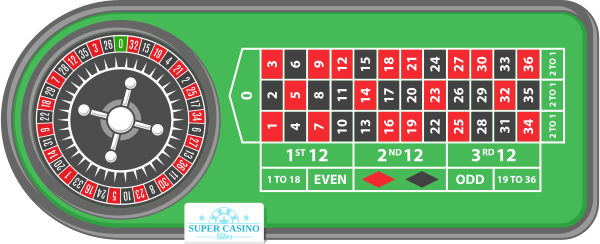
In French and European roulette there are 37 pockets on the wheel. The probability of predicting the winning one is 1 in 37. It stands to reason that the chance for you to lose is 36 to 1, which is what you should be paid, the true odds. However, the casino odds (also known as the payout) on a Straight Up bet are 35:1. This difference in risk to payout constitutes a house edge of 2.7%. This is calculated by using the following logic. A winning Straight Up bet awards 35 chips, plus the one we wagered, so that makes 36 in total. The total possibilities are 37, so 37 – 36 is a difference of 1. Statistically, one out of 37 spins will be lost; 1/37 ≈ 0.027. Converting that to a percentage, 0.027 × 100 = 2.7%, and that is the so-called house edge.
American roulette, on the other hand, features 38 pockets on the wheel because of an extra pocket for the double zero. This almost doubles the house edge to 5.26%. Following the same logic, we can see that there is a 1 in 38 probability of winning a Straight Up bet. The true odds are 37 to 1 since there are 37 instances where we can lose and 1 where we win. The payout, however, is still 35:1. The difference is 38 – (1 + 35) = 38 – 36 = 2. The house advantage is 2/38, which is ≈0.0526 or 5.26%.
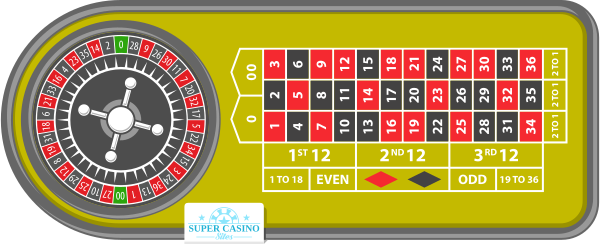
A bet exclusive to American roulette is the Five Number Bet, where you bet on numbers 0-00-1-2-3. This pays at 6:1, which ultimately raises the house advantage to ≈7.89%.
The ‘la partage‘ or ‘en prison‘ rules in French roulette have a significant effect on the house edge. Since you get a second chance at an outside bet or retain half of your original bet respectively, this reduces the house edge by half, bringing it down to 1.35%. French roulette is the most favorable of all roulette versions for players for this reason.
Bet Types and Odds
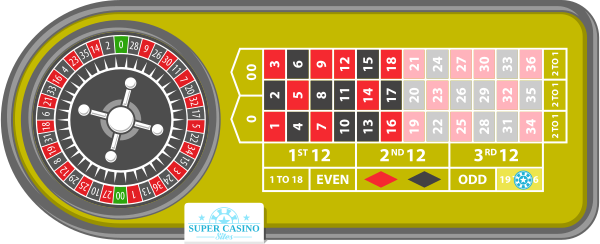
Wagers placed at the roulette table fall into two categories: Inside Bets and Outside Bets. Inside Bets refer to bets placed inside the number grid, either on a single number or on a group of numbers. Here are all of the Inside Bets that you can place:
Straight Up Bet – A Straight Up Bet is a wager on a single number on the grid. Chips are placed inside the rectangle and should not touch the borders. You can bet on any of the 36 numbers, the zero, or the double zero (if there is one). Winning a Straight Up bet pays 35:1.
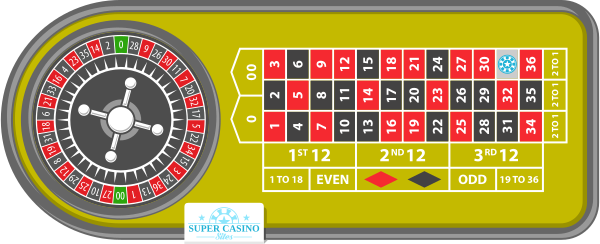
Split Bet – A Split Bet involves betting on two numbers simultaneously. To place a Split Bet you put your chips on the line that separates the two numbers. If the ball falls on either of the two numbers you win the bet. The payout ratio is 17:1.
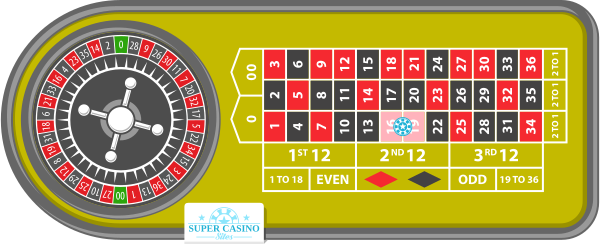
Street Bet – This is betting on a row of three numbers on the grid, for instance, 10-11-12. You place the chips on the outside border of the row. If any of the three numbers wins, the bet pays 11:1.
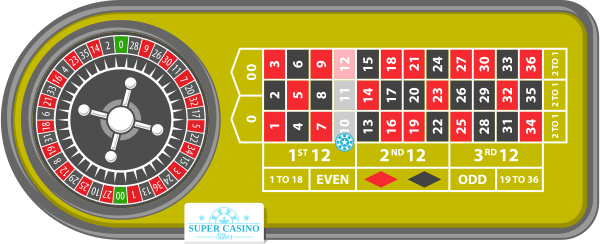
Corner Bet – A Corner Bet is a bet placed on a block of four numbers. You have to place your chips on the spot where four numbers meet. If the ball lands on any of these numbers you will receive a payout of 8:1.
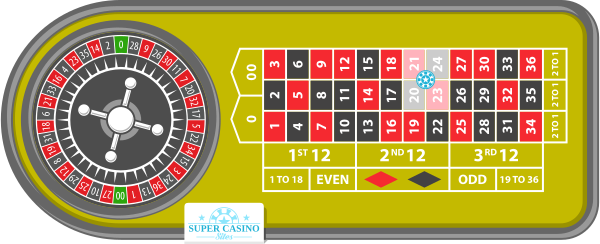
Five Number Bet – This involves placing a bet on the first five numbers: 0-00-1-2-3. This bet exists only in American roulette, since that is the only variant of roulette with a double zero pocket. It is sometimes referred to as the Sucker Bet because the payout is 6:1. In reality, it should be 6.2:1 to make up for the double zero, but as it is, the house edge on this bet rises from 5.26% to 7.9%.
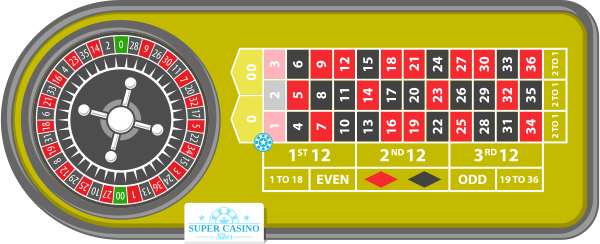
Line Bet – A Line Bet is very similar to a Street Bet, but it involves betting on two rows instead of one. You place your chips on the outside border where the two rows meet. This bet has a payout ratio of 5:1.
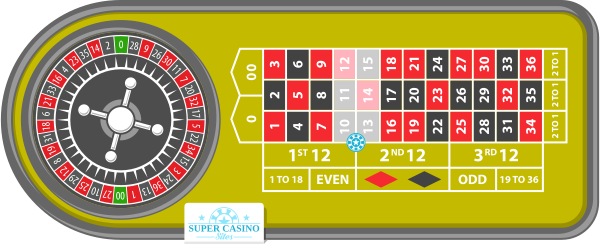
Outside Bets refer to all other betting options not found in the numbers grid.
Dozens Bet – There are exactly 36 numbers on the grid, excluding any zeros, which means you can place a bet on which group the winning number will belong to. Typically, the groups are as follows: 1st Dozen includes numbers 1-12, 2nd Dozen 13-24, and 3rd Dozen 25-36. The zero and the double zero are excluded from these groups, so if the ball lands on either of them you will lose the bet. If, however, you win, you will receive a payout of 2:1.
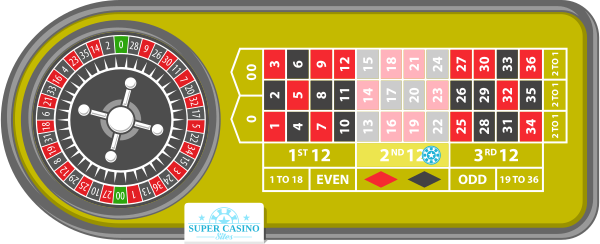
Column Bet – Similar to the Dozens Bet, the Column Bet also involves wagering on a column of 12 numbers. The Column Bet has a payout rate of 2:1 and does not involve the zeros.
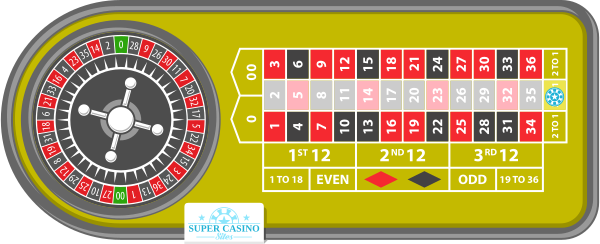
Color Bets – As you have probably noticed, the numbers on the roulette wheel are marked in two colors: red and black. You can place bets on the color of the winning number. This bet pays 1:1, also called even money. The zero pockets are normally colored green and if the ball lands in one you will lose.
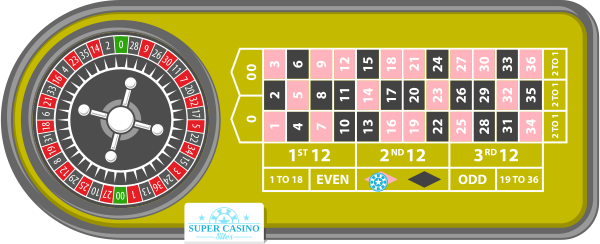
Odd or Even – This bet should be self-explanatory, but we will still cover it. You can place a bet on whether the winning number will be odd or even. There are 36 numbers in total, so you have 18 odd and 18 even numbers. The zeros, however, are neither odd nor even, and if the ball lands on them you will lose this bet. If you win, however, you will receive even money.
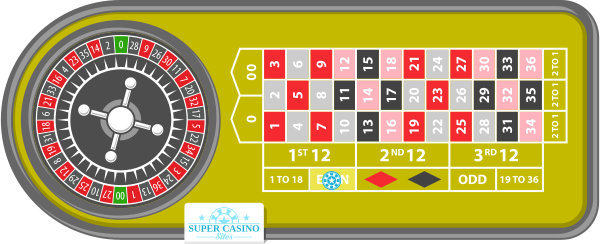
Low or High – Here you place a bet on either the Low (1-18) or the High (19-36) group of numbers. Whichever group the winning number belongs to wins. This bet pays even money and zeros are, naturally, excluded.
Call Bets
A call bet is not something found at every casino or roulette table. They are usually reserved for high-class establishments where high rollers are the main clientele. A call bet is when a player does not immediately place chips on the table to cover the cost of the bet; rather, the casino extends credit to that person. This is not readily available in every casino, however. Some casinos may be hesitant to give a player credit on the spot, whereas in some countries, such as the UK, the practice is illegal.
Call bets should not be confused with announced bets. While similar at first, the main difference between the two is that when a player makes an announced bet, they immediately place the chips to cover the cost of the bet.
There are several combinations of numbers that have names attached to them, commonly referred to as the ‘French Bets‘. Each covers a different section of the roulette wheel, and a separate bet may be placed on each one. The series of numbers is determined by the way they are placed on the wheel.
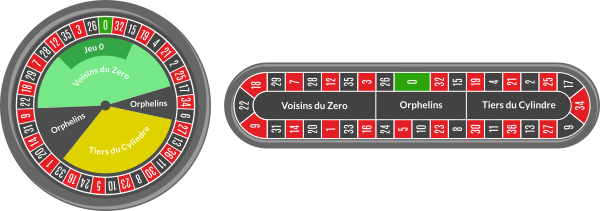
Call Bets Additional TipsVoisin de zero – this bet covers the numbers between 22 and 25, including 22 and 25. The series covers 22-18-29-7-28-12-35-3-26-0-32-15-19-4-21-2-25. At least 9 chips, or multiples of 9, must be wagered to place this bet. Two chips are placed on 0-2-3, one on the 4-7 split, one on 12-15, one on 18-21, one on 19-22, two on the corner covering 25-26-28-29, and one on the 32-35 split.
Jeu zero – this bet covers the five numbers closest to zero and is relatively inexpensive to make. One chip is placed on the 0-3 split, one on the 32-35 split, one on the 12-15 split, and a Straight Up bet on 26.
Le tiers de cylindre – “a third of the wheel” in French, this bet covers 12 numbers, which is as close to a third of a roulette wheel as you can get. It includes all of the numbers between 27 and 33; more specifically, the sequence is 27-13-36-11-30-8-23-10-5-24-16-33. It takes six chips to place this bet.
Orphelins – This bet translates as “orphans” and it covers eight numbers positioned on two opposite sides of the wheel. One series is 1-20-14-31-9, the other is 17-34-6. Five chips or multiples thereof are necessary to place this bet – one chip for a Straight Up bet on 1 and four other chips for the splits 6-9, 14-17, 17-20, and 31-34.
The neighbours – Betting on a number and the four surrounding it. For instance, when you bet on 4 and the neighbours, you wager on numbers 15-19-4-21-2. You wager a minimum of five chips or any other multiple of five.
Final bets – This is a wager where you bet on specific numbers ending in X. For instance, a Final 5s bet includes numbers 5, 15, 25, and 35. You wager between 3 and 4 chips, depending on your number of choice. Final 0 through Final 6 cost 4 chips, and Final 7 through Final 9 cost 3 chips.
Please note that call bets are considered a courtesy and will be placed only if the dealer has time to do so. If the bet is accepted, the croupier will announce it; if not, they will say “No bet!”. Arguing over your bet not being accepted is considered a serious breach of etiquette.
Live Dealer Roulette Gameplay
Choosing a Roulette Casino
When you are choosing a casino to play roulette, there are several things that you need to consider before reaching a decision. You should look up the establishments that you wish to visit and see what they are offering. You should look for the versions of roulette that give you the best odds. These are European or French roulette. French roulette features rules that are beneficial to you and has a house edge of only 1.35%. Furthermore, you should ask about the betting limits on the available tables to see if they fit within your targeted budget.
Improving Your Chances to Win
To improve your chances of winning, you have to play at the best possible odds. For starters, if you have the opportunity to play at a table with a French wheel, do so; it will decrease the house edge by almost half compared to the more commonly found American wheel. The American version of roulette features an extra double zero pocket but does not change the payout ratio. As a result, the probability to win a Straight Up bet shifts from 1 in 37 to 1 in 38, but the same 35:1 payout remains. This pushes the house edge further in favor of the casino. To avoid this you should ideally play French or European roulette. Between these two versions, the French one has the lower house edge, since it often features a ‘la partage’ or ‘en prison’ rule.
Furthermore, you should keep your bets as close to the table minimum as possible. This way you can play longer and not completely lose your bankroll if things do not go as planned.
The very nature of roulette is meant to be a money sink, especially if you are only placing Straight Up bets. The chance to win a single Straight Up wager stands at roughly 2.7%, or, in other words, very slim. Therefore, it is recommended that you stick to placing several Outside bets at once. If you place one bet on red and one on the Third Dozen, you are much more likely to win than if you just wager on a single number. Outside bets give you the chance to win a decent amount in the short term because of their relatively high win probability. Playing for prolonged periods is not something that we recommend, since roulette, like all casino games, is designed to favor the house in terms of odds.
Inside vs Outside Bets

As you have probably noticed, the Outside bets offer a higher probability of winning, even at the cost of lower winnings. Inside bets, on the other hand, feature a lower probability and higher payouts.
Betting on Multiple Numbers
In order to win more often, some players like placing bets on several numbers at the same time. There are some things that should be noted about bets such as these.
Inside vs Outside Bets Additional TipsDepending on how you prefer playing and what your goals are, you may want to stick to one particular type of bet. If you gamble for the thrill and excitement, then Inside bets may be the right type for you. If, instead, you prefer a more stable style of play, the even-money wagers that Outside bets offer are probably more to your liking.
Betting on Multiple Numbers Additional TipsBetting on multiple numbers is significantly more expensive than making a Split Bet, Corner Bet, or Street Bet, as you are placing a chip on each individual number. The other types allow you to place a bet for a single chip. If it is possible to bet on all of those numbers at once using a single chip, it is a much more favorable option. It will be easier on your wallet in the event that you lose.
Managing Your Bankroll

Playing roulette can have a drastic effect on your wallet, since at a land-based casino the game plays at least 60 spins per hour, and so you need to carefully manage your bankroll unless you want to find yourself penniless.
En Prison and La Partage

These two rules are featured exclusively in the French version of roulette and are meant to give the player the chance to reclaim part or all of the bet when losing an Outside bet after the ball lands in the zero pocket.
Managing Your Bankroll Additional TipsSince roulette is a game of chance, there is always the possibility that you may lose everything, so do not bring to the table more money than you are willing to lose. Casino games are set up in a way that always ensures that the house wins in the long run. With that in mind, you should not stay at the table for too long, as that increases the risk of ruin. Furthermore, in the event that you actually lose everything, do not deposit more money with the intent to win it back. This is a slippery slope that many gamblers have fallen down in the past and it rarely brings the desired results.
En Prison and La Partage Additional TipsThe ‘en prison’, meaning “in prison,” states that when a player has placed an Outside bet and the ball lands on zero, the bet is not lost; rather, it stays on the table for the next spin. The outcome of that spin will determine what happens to the bet. If the ball lands on zero again, then the bet is lost.
The ‘la partage’ rule allows the player to keep half of a losing Outside bet when the ball lands on zero. Both rules favor the players since they bring down the house edge to a very acceptable 1.35% for even-money bets because half the money is given back when losing such a bet.
Basic Rules
The basic goal of roulette is to correctly predict where the ball will land. Depending on the version of roulette, the wheel features 37 or 38 pockets, each representing a number that you can bet on. You place your bets and the dealer will spin the ball, which will eventually land somewhere on the wheel. Once the ball has been spun, you cannot change or remove any of your bets. The game is usually played by up to eight people who play against the house.
Roulette History
Roulette dates back to at least the 18th century. Blaise Pascal is said to have invented a more primitive version of the roulette wheel in the 17th century in his attempt to create a perpetual motion machine. While he did not manage to break any of the laws of physics, he did contribute to the creation of one of the most popular casino games of all time. What we currently know as roulette has been played in casinos since at least the 1790s in France. Since then the game has risen in popularity, being featured in numerous casinos throughout Europe and eventually making its way to the United States. The single-zero wheel became the dominant version in Europe, while the double-zero one gained prominence in the Americas. Currently, roulette is featured in casinos across the world, from Las Vegas to Atlantic City, in many casinos in Europe, and all the way to Macau.
Roulette FAQ
If you are new to the world of roulette there are probably questions that you would like answered. So here are several of the most-asked questions regarding roulette.
How are each individual player’s chips distinguished from those of other players?
Each player is assigned their own chips that are colored differently. This way the dealers always know with certainty who made what bets. These chips are unique to the roulette table and can only be used there. Upon first coming to the table, your standard casino chips will be exchanged for roulette chips, and vice versa when you leave the table.
If the ball has not landed on a certain number for a while, can I expect it to hit soon?
If you are thinking that a certain number is “due,” then you would be completely wrong. Each spin on roulette is independent of the previous ones. There is always the possibility that a number may come up several times in a row or never at all. Probability dictates that the ball may land in that pocket; it does not guarantee it.
Can the dealer land the ball in a certain pocket?
It is possible but very improbable. The ball is spinning, as is the wheel, so the chance of landing the ball in a precise pocket is practically zero.
Do I have a 50-50 chance of winning an even-money bet?
While even-money bets pay at a 1:1 ratio, the chance to actually win one is not 50-50. French and European roulette feature a single zero pocket, while the American version features two. So you have an 18 in 37 chance to win an even-money bet on European or French roulette, and an 18 in 38 chance in American roulette. This difference between probability and payout is what is referred to as the house edge.
Roulette Glossary
If you have ever been at a roulette table you will no doubt have heard several terms that experienced gamblers use. Like most casino games, a whole subculture has emerged around roulette. Here are some of the more popular jargon terms that you may encounter while playing the game.
Action
The total amount of money wagered over a certain period of time.
Biased Numbers
Numbers that come up more regularly due to a biased wheel.
Biased Wheel
A flawed wheel due to continuous use and wear.
Black Action
Placing a black chip, which is worth $100.
Cage
Refers to the area where chips are exchanged for cash.
Carre’
French word for Corner Bet.
Cheval
French word for a Split Bet.
Choppy Game
A game where neither the casino nor the players are making significant wins.
Cold Table
A table where no player is making significant winnings.
Croupier
French word for dealer.
Even Money
Any bet that pays at a 1:1 ratio.
Flat Betting
Placing bets of the same size on every spin.
Floorman
Also called a Pit Boss, a casino employee responsible for the management of all tables.
Gaffed Wheel
A rigged wheel.
House Edge
The long-term statistical advantage that the casino has over the players, also called the Casino Advantage.
High Bet
A bet on numbers between 19 and 36.
Pit
The area where the table games are located.
Quarters
Chips valued at $25.
Sacred Money
A player who is betting money they cannot afford to lose is gambling with Sacred Money.
Section Shooter
A dealer who is attempting to land the ball in a specific section.
Stack
Twenty roulette chips.
Surrender
A feature sometimes available in American roulette that lets a player keep half of the wager on a losing Outside bet when the ball lands on zero. Similar to the ‘la partage’ rule in French roulette.
True Odds
The correct probability of a bet.
Wheel Chips
Refers to the chips used specifically at a roulette table.