Roulette has been the face of casino gambling for as long as anyone can remember. When you imagine a casino hall, one of the first things to come to mind is probably a roulette table. Watching the wheel spin has been a passion of countless players over the decades and even centuries. The game in its current form dates back to 18th-century France, when it was featured in many high-class establishments. It gained popularity over the years and is currently one of the most beloved casino games around the world. You will find a roulette table in every casino worth its salt.
For those who are not entirely familiar with this classic game, or who are looking to brush up on their knowledge of it, please read on as we explain all the important aspects of roulette.
Roulette Table
The roulette table is pretty much identical across all versions of the game. Naturally, you can expect to find the wheel and the betting options. There is a grid of numbers from 0 to 36, often referred to as Inside bets. Here, you can bet on a single number or on a small group of numbers positioned close together on the layout. To the side, you will find the Outside bets, where you can wager on broader factors, such as the color of the winning number or whether it is high or low. The main distinguishing features between the two types of bets are probability and payout. Inside bets tend to pay more but have a lower probability of winning, whereas Outside bets are the opposite.
Of course, we have to mention the contraption that gives the game its name, the wheel. Roulette means ‘small wheel’ in French and it is an integral part of the game. There are several fundamental differences among the wheels used in the main versions of roulette: the American, French and European.
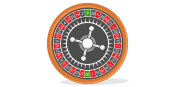
American Wheel

French Wheel
American Wheel
This type of wheel is found in North and South American casinos and, in general, in any American Roulette game. The wheelhead features 38 pockets: 36 for numbers 1 through 36 and 2 for the zero and the double zero.
Half of the 36 pockets are black and the other half are red, with the colors alternating. The zero and double-zero pockets are both colored green. The two are always on opposite sides of the wheel, facing each other.
The numbers come in the following sequence when counting counterclockwise: 0, 2, 14, 35, 23, 4, 16, 33, 21, 6, 18, 31, 19, 8, 12, 29, 25, 10, 27, 00, 1, 13, 36, 24, 3, 15, 34, 22, 5, 17, 32, 20, 7, 11, 30, 26, 9, 28. This roulette wheel differentiates itself from other styles because it features an extra pocket for the double zero.
Because of this, American wheels are referred to as double-zero wheels. The addition of a double-zero pocket causes the house edge to rise to 5.26%, which is nearly twice as high as that in single-zero roulette games.
French Wheel
This wheel is used in both French and European Roulette games because the two are practically identical. It is predominantly found in Continental Europe and Asia. Unlike the American wheel, which has 38 pockets, the French one features only 37.
It includes 36 pockets for numbers 1 through 36, colored black and red and alternating, plus a single zero pocket colored green. The sequence of numbers is unique to this wheel and it goes as follows: 26, 3, 35, 12, 28, 7, 29, 18, 22, 9, 31, 14, 20, 1, 33, 16, 24, 5, 10, 23, 8, 30, 11, 36, 13, 27, 6, 34, 17, 25, 2, 21, 4, 19, 15, 32. As you can see, there is no double-zero pocket on the French wheel, which means that it has a low house edge at 2.7%. This is the main difference between the French and American wheels.
However, there are still some differences between European and French Roulette. For instance, the French version features either the ‘en prison’ or the ‘la partage’ rule. These rules reduce the house edge even further to 1.35% for even money bets, making the French version the most favorable of all.
Roulette Bets
Roulette offers a plethora of betting options not normally found in other casino games. As mentioned above, these fall into two separate categories: Inside and Outside bets. One of the best things about roulette is that you are not limited to a single bet. In fact, you can place as many bets as you like, regardless of whether they are Inside or Outside bets.

Inside Bets

Outside Bets
Inside Bets
Inside bets are those found on the grid, featuring numbers 1 through 36, as well as the zero and double zero (in American Roulette only). You can place bets on single numbers, rows, columns, and more. Below you will find a full list detailing these bets and their respective payout ratios.
Inside Bets Payout
- Straight Up (single number) – Pays 35:1
- Split (two numbers) – Pays 17:1
- Street (three numbers) – Pays 11:1
- Corner (four numbers) – Pays 8:1
- Basket (0-00-1-2-3) – Pays 6:1 (only featured in American Roulette)
- Line (six numbers) – Pays 5:1
Outside Bets
Outside bets are located around the grid and offer different betting options. When placing an Outside bet, you are wagering on factors such as color, odd or even, high or low, and similar options. If the ball lands in a zero pocket, any Outside bets will be lost. Below you will find all of the Outside bets and their payout ratios.
Outside Bets Payout
- High or Low – Pays 1:1
- Red or Black – Pays 1:1
- Odd or Even – Pays 1:1
- Dozen (one group of 12 numbers) – Pays 2:1
- Column (a column of 12 numbers) – Pays 2:1
Roulette Variations
There are several versions of roulette that have become popular over the years. The most significant differences are the wheel layout and the number of pockets. The roulette layout is basically the same, as are the betting options. Because the wheels differ, the probability in each game varies. Some versions also include specific rules not found in others. These factors may seem trivial to new players, but to experienced ones they have a significant effect on how the game plays. Below you will find a detailed explanation of each popular version of roulette currently featured in land-based and online casinos.
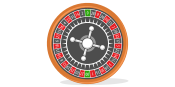
American Roulette
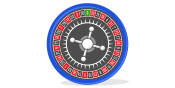
French Roulette
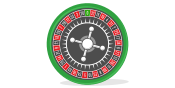
European Roulette
American Roulette
American Roulette is perhaps the most played version of roulette in brick-and-mortar establishments. This type of roulette emerged in the United States during the 19th century as the country was expanding westward. Currently, American Roulette is predominantly played in the Americas, whereas French and European versions are popular in Europe and Asia.
American Roulette differs from other versions by featuring a double-zero pocket. This pushes the house edge further in favor of the casino. The number sequence on the wheel is also slightly different from that of French and European roulette wheels. In some American casinos, you may encounter the ‘Surrender’ rule. It is practically identical to ‘la partage’ in French Roulette, allowing you to recover half of your wager if you placed an Outside bet and the ball lands in a zero pocket.
French Roulette
French Roulette is nearly identical to European roulette except for slight rule changes. The French version of roulette features the ‘la partage’ or ‘en prison’ rule. ‘La partage’ literally means ‘splitting’, and the rule applies when you place an Outside bet and the ball lands on zero. If that happens, half of your bet is returned and the house claims the other half.
‘En prison’ means ‘in prison’ in French, and it applies when you have placed an Outside bet and the ball lands on zero. In this case, you do not lose your money immediately; instead, it remains on the same Outside bet for the next spin, which determines whether you will win or lose.
These rules are beneficial to the player because they allow at least a portion of a losing bet to be reclaimed. This makes French Roulette the most favorable roulette variation in terms of odds.
European Roulette
European Roulette is one of the most popular versions of roulette worldwide. It is featured in many land-based casinos across the globe, as well as in online ones. This version of roulette features 37 pockets for the numbers 1 through 36 and the zero. Unlike American Roulette, this version features only a single zero pocket, making the odds much more favorable.
Roulette Misconceptions and Superstitions
It is a common fact that gamblers are among the most superstitious people in the world. Every popular casino game is accompanied by several nonsensical rituals and misconceptions. In the case of roulette, a game of pure chance, players have invented various factors to justify their wins or losses and to entice fate to favor them. Naturally, these have no real effect on the game, so you should not take them seriously and should avoid them whenever possible.

Overdue Numbers

Hot Numbers

Lucky Numbers

Cursing at the Ball
Overdue Numbers
When the ball has not landed in a specific pocket for a long time, you may hear people say the number is ‘overdue’ and will appear soon. This belief, known as the Gambler’s Fallacy, is the idea that something has to happen simply because it has not happened for a while. There is no logical reasoning behind this.
While it is unlikely for a number never to hit, you must understand how probability works in casino games. Casino games have no memory, whether you play them online or at a brick-and-mortar venue. The previous spin has no effect on the next, as each is independent from the other. While very improbable, it is possible for a number to hit several times in a row. For example, in 1959 at a casino in Puerto Rico, the number 10 came up six consecutive times. The odds of this happening are extremely low, 1:3,010,936,384. The point is that no spin is influenced by previous ones, and no number is ‘overdue’ at any point in the game.
Hot Numbers
This situation is similar to the previous one. When certain numbers appear more often than others, some players may say they are ‘hot’ and that you should bet on them. Disproving this argument is simple. Just like ‘overdue’ numbers, ‘hot’ ones are not influenced by any previous spins.
The odds for the ball to land in a particular pocket are fixed and do not change. If the results are the same or similar on several consecutive spins, it is merely the product of chance and nothing else. There are simply no other factors involved.
Lucky Numbers
People often believe they have a lucky number. As nice as it would be if that were true, reality is quite different.
Whether you bet on your anniversary date, your grandmother’s birthday, or the number of children you have, it will not affect the outcome of the game. The only benefit of a lucky number is that it provides an immediate choice when, for some inexplicable reason, you cannot decide what to bet on.
Cursing at the Ball
In some gambling circles, a notion has flourished that cursing at the ball will cause it to land in your chosen number’s pocket. This idea is both ridiculous and somewhat amusing.
The ball is obviously an inanimate object, so whether you plead with it, swear at it, or speak kindly to it, the result will not change.
Betting Systems
 In a game like roulette, players naturally want to win and make as much money as possible in the process. To achieve this goal many gamblers utilize betting systems to regulate their bets and gain as much advantage as possible. These strategies have received mixed responses from the general public. For every person who swears by them, there is another who claims that they hold no value. Whatever the truth may be, it is clear that betting systems are quite popular among gamblers, and they are likely to stay that way.
There are basically three types of betting strategies: flat betting, positive progression, and negative progression. Flat betting, in reality, is not so much a strategy as a way to keep your sessions consistent. It is the way most people play without even realizing it, essentially placing the same bet over and over again without alteration. By choosing this style of play, you can effectively predict the minimum number of spins you will play. It is relatively safe and consistent.
Progression systems are completely different, in that when you use one you are required to constantly change the size of your bets depending on the previous outcome. A positive progression has you placing larger bets after each winning spin, whereas a negative progression will have you increasing your bets after losses and lowering them after winning. Both systems have different philosophies associated with them. Negative progressions have you placing higher bets in order to win back what you have lost and to generate a decent profit. Positive progressions, on the other hand, imply that any losses can be overlooked when you take into account the massive payoff from a winning streak. Each system has its own pitfalls and shortcomings, but neither is completely without merit. If utilized properly, both strategies can give you the desired outcome, but you have to consider that roulette is inherently a game of pure chance. There are no outside factors that can help you manipulate the game in your favor.