
Blackjack is a slightly deceptive game. Its simple rules of play may fool you into believing it is easy to master, but if you delve deeper, you will quickly find that it is a purely mathematical game that is all about odds and probabilities. Blackjack Hall of Fame inductees Edward Thorp and Julian Braun were among the first people to reach this realization in the 1960s. They ran millions of simulations on old IBM computers to refine the basic blackjack strategy Ed Thorp published in his book Beat the Dealer, which is now a classic in the blackjack canon.
If you truly want to win at this game, you need to gain a good understanding of what the odds and probabilities are for every possible scenario at the table and base your playing decisions on these odds. The following article aims to introduce you to the foundations of blackjack odds and probabilities. Toward the end, we have also included several charts that may prove useful.
Understanding Blackjack Probabilities
 Many people use “probability” and “odds” interchangeably, but there is a pronounced difference between the two. While inherent in gambling, probability is, first and foremost, a separate branch of mathematics that deals with the likelihood of different events occurring. Probability permeates all aspects of our lives, from weather reports to statistics and even games at your local casino.
Probability is calculated on the basis of known data but cannot be used to predict exact outcomes, such as the result of a hand in blackjack. It simply shows you the likelihood of an event happening, based on the number of desired outcomes and the total number of possible outcomes. You can use this knowledge to execute the best play at the blackjack table, but it does not, by itself, reveal with absolute certainty which card the dealer will pull next.
Statisticians use what is known as a “probability line” to represent the likelihood of events, which can be classified as certain, likely, unlikely, or altogether impossible. The farther to the left an event is positioned on the probability line, the less likely it is to take place. Conversely, the farther to the right of the line’s center an event sits, the more likely it is to occur.
The probability of a given outcome is quite simple to calculate. All you have to do is divide the number of desired outcomes by the total number of possible outcomes. In the context of gambling, this translates into dividing the number of ways to win by the total number of possible outcomes.
Independent vs. Dependent Trials
 Before we proceed with concrete examples, we would like to distinguish between independent and dependent events (or trials in statistics). An independent event has no impact on another event’s probability of occurring (or not occurring). This is the case with dice throws in craps and with roulette spins, where previous outcomes have no influence on the trials that follow.
Here is an example of determining the probability of rolling a 2 with a six-sided die. There is only one possible way to roll a 2 out of six possible outcomes. It follows that the likelihood of rolling a 2 is 1/6 = 0.166 * 100 = 16.66%.
The probability of rolling a deuce with two dice is even slimmer because there are more permutations (36 to be precise), but there is only one two-dice combination that results in a total of 2. Accordingly, the likelihood of this independent event occurring is 1/36 = 0.027 * 100 = 2.77%. No matter how many times you throw the dice, the probabilities for the trials will always remain the same.
With dependent events, previous trials influence the probabilities of the trials that follow. Unlike roulette and dice games, blackjack is a game of dependent trials in which each card dealt changes the composition of the remaining deck and therefore influences the likelihood of forming specific hands in subsequent rounds of play.
This phenomenon is best explained through examples. Let’s calculate the probability of drawing an Ace from a single deck of cards. Single-deck blackjack uses a full deck of 52 cards without jokers. There are 13 ranks in four different suits, which means there are only four Aces in 52 cards. Therefore, the likelihood of pulling an Ace at random is P(Ace) = 4/52 = 0.0769 * 100 = 7.69%.
Independent vs. Dependent Trials Additional TipsAssuming the Ace you have already drawn is discarded instead of being returned to the pack, the probability of pulling an Ace on the next trial will be slimmer. Three Aces remain and the number of cards in the deck has now dropped to 51. The calculations are as follows: P(Ace) = 3/51 = 0.0588 * 100 = 5.88%. The more cards of a given rank that have left the deck, the smaller the likelihood of drawing a card of that rank on your next try.
The only unknown factor in the game of blackjack is which card we will pull out next. We can determine the probability of drawing a specific card but cannot say with absolute certainty which card will leave the pack on the next draw.
The only random factor that impacts the draws is the reshuffle. If we place the Ace back into the deck and reshuffle after each trial, the probability of pulling it will remain the same, as you will now be dealing with independent trials.
Another Example – Hard 16 vs. Dealer 10 (No Surrender)
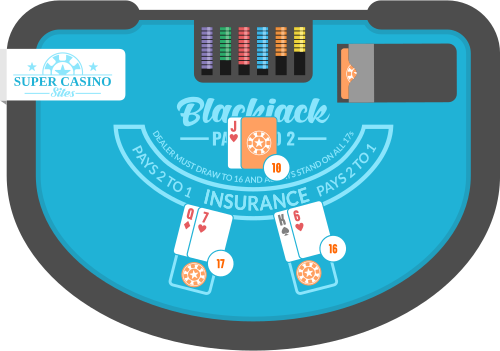 Let’s demonstrate how blackjack probabilities work when more cards have left the deck. We will assume you start a fresh round in a no-hole-card game after the single deck has been reshuffled. You are dealt Q-6 against a dealer K, but surrender is unavailable, in which case you are forced to hit your hard 16. What is the likelihood of improving your total on the next hit?
We are left with 49 cards, as three cards have already been removed from the deck. The following cards can help you improve your 16: an Ace for a total of 17 (the Ace will be counted as 1 here, as otherwise it would bust your hand), a deuce for 18, a 3 for 19, a 4 for 20, and a 5 for the best possible outcome of 21.
Thus, you have 20 helpful cards out of 49. The probability of drawing a “good” card is 20/49 = 0.408 * 100 = 40.8%. Conversely, the likelihood of busting by pulling one of the 29 “bad” cards is 29/49 = 0.591 * 100 = 59.1%.
The Probability of Obtaining a Blackjack
 Naturals are the strongest hands you can obtain in the game of 21. Not only is it impossible to lose with a natural (in the worst-case scenario you will push with the dealer), but you earn a little extra because blackjacks return 1.5 times your original bet (provided you are not foolish enough to play 6-to-5 games). Because of this, it is important to understand the probability of receiving blackjacks.
Knowing the number of decks in play, you can easily determine the likelihood of receiving a natural after the reshuffle. For this purpose, multiply the probability of pulling an Ace by the probability of pulling a ten-valued card like 10, J, Q, or K (there are four of each in a single deck for a total of 16). You must then multiply the result by 2 because there are two possible permutations of cards in a blackjack hand, for example A-Q and Q-A, K-A and A-K, and so on.
The probability of drawing an Ace is 4/52, while that of pulling one of the ten-value cards is 16/51. The number of cards drops to 51 in the second case to account for the Ace that has already been removed from the deck. Therefore, we calculate the probability of being dealt a blackjack as follows: P(Ace) * P(ten-value card) * 2 = (4/52) * (16/51) * 2 = 0.0482 * 100 = 4.82%.
The likelihood of receiving naturals decreases as more decks are introduced into the game, which, in turn, slightly increases the casino’s advantage over you. This often sounds counterintuitive to inexperienced players who believe it should be the other way around because there are more Aces and ten-value cards when multiple decks are used.
The Probability of Obtaining a Blackjack Additional TipsThis line of reasoning is erroneous because the effect of individual card removal is not as pronounced in multiple-deck games as it is in single- or double-deck variations. The probability formula we use is the same, however, no matter how many decks are in play.
Below are the probabilities of drawing a blackjack at the start of a fresh shoe with two, four, and six decks. You will notice that the difference becomes less pronounced as more decks are introduced. The difference in blackjack probabilities between six and eight decks is so small we did not bother to include the calculations here.
- The probability of a blackjack with two decks is (8/104) * (32/103) * 2 = 0.0479 * 100 = 4.77%
- The probability of a blackjack with four decks is (16/208) * (64/207) * 2 = 0.0475 * 100 = 4.75%
- The probability of a blackjack with six decks is (24/312) * (96/311) * 2 = 0.0474 * 100 = 4.74%
Live Dealer Blackjack Gameplay
Converting Probability into Odds
 Odds differ from probability in that they show the ratio between the number of desired outcomes and the number of ways the desired outcome will not occur. In the context of gambling, this corresponds to the ratio between winning and losing outcomes. Unlike probability, odds are normally expressed as fractions rather than percentages.
Here are a couple of examples so you can get a firmer grasp on how odds work. Let’s suppose you want to know the odds of hitting number 9 on a single-zero roulette wheel, which has 37 numbers in total. Only one number wins, so there are 36 ways to lose. Accordingly, the odds of succeeding are 1 to 36, or 1/36. This corresponds to an implied probability of 2.70%, which, oddly enough, coincides with the advantage of the casino in this game.
Consider another example with a single-deck blackjack game. What are the odds of pulling the Queen of Spades from a 52-card pack? There is only one Queen of Spades in the deck, as opposed to 51 cards of other suits and ranks, so the odds of drawing this card are 1 to 51, or 1/51.
In gambling, odds are normally expressed in reverse, showing you the chances “against” an outcome occurring, like so: 51 to 1 and 36 to 1. You can convert implied probability into odds with the following formula: (100/P) – 1, where P stands for probability.
Converting Probability into Odds Additional TipsIn the roulette example with number 9, the calculations go as follows: (100/2.70) – 1 = 37.03 – 1 = 36.03, or roughly 36 to 1. In the case of the Queen of Spades, the implied probability of 7.69%, when converted into “odds against,” corresponds to (100/7.69) – 1 = 13 – 1 = 12, or 12 to 1.
The above calculations show the true odds of hitting a 9 and of drawing the Queen of Spades from a full 52-card deck on the first trial. The casino extracts its advantage (and profits) by ensuring it always retains a percentage of all players’ cumulative wagers.
In games like roulette and craps, this is achieved solely through payout reduction. The true odds of hitting an individual number on a single-zero wheel are roughly 36 to 1, whereas the casino pays only 35 to 1. In blackjack, the house extracts its edge in a variety of ways, including payout reduction for naturals (6 to 5 instead of 3 to 2), unfavorable rules, and increasing the number of decks in play.
The Probability of the Dealer Busting and the Effect of Cards’ Removal
 In blackjack, the odds and probabilities fluctuate with each card that leaves the deck or shoe. This happens because small cards, 2 through 6, favor the dealer, whereas high cards, 10, J, Q, K, and A, favor the player. Cards 7 through 9 are neutral because they favor neither the player nor the dealer.
The dealer has higher chances of exceeding 21 when they start their hand with small cards like 4, 5, and 6. The player’s advantage increases when the dealer exposes one of these cards. Conversely, the player’s advantage begins to drop when high cards are removed from the deck. Examine the table below for more information on the dealer’s probability of busting with individual upcards.
| The Dealer’s Exposed Card | The Probability of the Dealer Busting with This Card in S17 Games | The Player Advantage against a Dealer Showing the Card |
|---|---|---|
| Ace | 11.65% | -16.00% |
| 2 | 35.30% | 9.80% |
| 3 | 37.56% | 13.40% |
| 4 | 40.28% | 18.00% |
| 5 | 42.89% | 23.20% |
| 6 | 42.08% | 23.90% |
| 7 | 25.99% | 14.30% |
| 8 | 23.86% | 5.40% |
| 9 | 23.34% | -4.30% |
| 10, J, Q, K | 21.43% | -16.90% |
Blackjack is the only casino game where cards “have a memory,” since your chances of winning change each time a card is removed from the deck. In fact, this is the basic premise of card counting, which we discuss later in this guide.
When the composition of the deck or shoe is such that ten-value cards and Aces outnumber small cards, the player holds an advantage over the dealer. The reverse is true when there are more small cards left to be played. The table below shows how the cards of different ranks impact your chances of winning:
| Card That Leaves the Deck | Impact of the Card’s Removal on Players’ Chances of Winning |
|---|---|
| A | -0.59% |
| 2 | 0.40% |
| 3 | 0.43% |
| 4 | 0.52% |
| 5 | 0.67% |
| 6 | 0.45% |
| 7 | 0.30% |
| 8 | 0.01% |
| 9 | -0.15% |
| 10, J, Q, K | -0.51% |