
Blackjack may have given way to slots in terms of popularity, but it nevertheless remains the most played casino-banked card game in the world. The game yields a rather small house edge and follows relatively simple rules, although mastering it to a tee and becoming a pro is no picnic. You can find it in land-based casinos across the world, but playing blackjack online is also a viable option these days.
Joining a blackjack table for the very first time can be slightly intimidating for unseasoned players. The game is incredibly dynamic, and it often seems as if all other players at the table are well-versed in blackjack (although this is rarely the case).
Whether you are new to the game of 21 or simply need to revise the rules and refine your play, the following article is just the thing you need. The game is simpler than it initially appears, so read on to learn about blackjack’s basic premise, the rules, and their most common variations.
The Main Premise of Blackjack
 First and foremost, blackjack is a game banked by the casino, which means you are playing against the house instead of fellow players. The main premise of blackjack is that the player needs to have a hand whose total is closer to 21 than the dealer’s, but without exceeding this value.
The player wins when they have a hand with a higher total than the dealer’s, when they are dealt a blackjack (the strongest hand in the game, consisting of two cards, an Ace and a ten-value card, but more on this later), or when the dealer goes over 21, which is referred to as “busting,” “breaking a hand,” or “one too many.” When both the player and the dealer have the same hand total, they push, that is, nobody wins or loses.
The decisions of fellow players have absolutely no impact on the outcome of a round, as everyone is competing against the house. We shall tackle the basic player decisions later on in the article. For now, it suffices to say that unlike players, blackjack dealers have no say in how they play out their hands.
Instead, they follow fixed rules laid down by the house, but these may vary greatly at blackjack tables in different casinos. Because of this, cards in blackjack are normally dealt face-up, so there is no issue with other players or the dealer seeing your hand. An exception is made for single- and double-deck games, where players’ cards are dealt face-down. Now, let’s take a quick look at the equipment that is typically used at a blackjack table.
The Equipment at a Blackjack Table
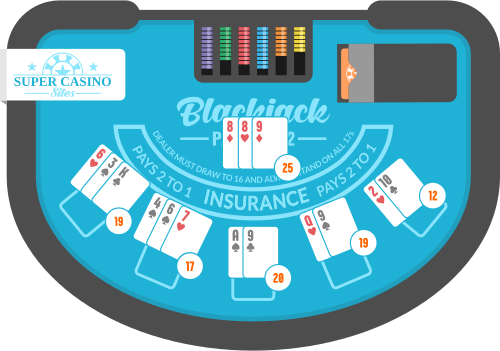 Blackjack uses one to eight standard decks of 52 cards, with the jokers removed from each pack. When the game of 21 made its debut in land-based casinos, it was originally played with a single deck of cards. In 1962, Ed Thorp published his bestseller, Beat the Dealer, where he explained how to gain a mathematical edge over the house through card counting.
The casinos responded by introducing multiple-deck games on the erroneous assumption this would hinder card counters from exploiting the game by keeping track of the cards. As a result, blackjack is typically played with four, six, or even eight decks nowadays. Of course, single- and double-deck games are still available both offline and online, but their unfavorable rules have practically rendered them unplayable.
In addition to the cards, you will spot several other pieces of equipment that are essential to the operation of a blackjack table. When multiple decks are in play, the dealer places all cards in a dispenser called a shoe. The blackjack shoe was introduced mostly for the purpose of holding larger stacks of cards in one place. However, it also hampers advantage-play techniques like hole carding, where the dealer fails to protect the hole card, allowing the advantage player to glimpse it.
A blackjack table also uses chips and a rack to store them, along with a tray where the dealer places the discards that are no longer in play. These are reintroduced into the game after the dealer reaches the cut card, which is a colored plastic card of the same size as regular playing cards.
The cut card is inserted at a random place in the shoe before the deal to indicate when the next reshuffle is to take place. The position of the cut card varies from one casino to another. Some establishments cut four decks in an eight-deck game; others cut two, but players are generally prohibited from inserting the cut card toward the end of the shoe.
The Equipment at a Blackjack Table Additional TipsHowever, one can argue a lower placement of the cut card is actually beneficial for the casino. Each reshuffle costs the house money because it slows down the action at the table and decreases the number of hands played per hour. And, as you will learn later on in this guide, the more hands you play per hour, the closer you get to the house edge, which ultimately causes you to lose money in the long term.
To prevent slowing down the game, many land-based casinos have introduced shuffling machines. There are two types of card shufflers you can come across at a blackjack table. The first type is the so-called Automatic Shuffling Machine (ASM).
This device, also known as a batch shuffler, significantly speeds up the shuffling process. After reaching the cut card, the dealer collects all cards and places them inside the machine instead of shuffling them manually. The device then reshuffles all the decks in a single operation.
In contrast, the Continuous Shuffling Machines (CSMs) used at some blackjack tables are always hard at work, constantly shuffling the decks. The dealer reinserts the cards into the machine after each round, which means no discard trays are used at CSM tables. One major downside of using CSMs (at least from the house’s perspective) is that these devices tend to change the order of the cards very slowly, making it possible for certain advantage players to shuffle-track the decks.
Live Dealer Blackjack Gameplay
Card Values in Blackjack
 Unlike poker, blackjack does not take the suits of the cards into consideration. An exception is made for some side bets, like Lucky Ladies (a pair of Queens of hearts) and King’s Bounty (a pair of Kings of spades), which award massive payouts of up to 1,000x the original stake but are rarely supported at blackjack tables.
By and large, only the numerical ranks of the cards matter in the game of 21. Cards 2 through 10 are assigned their face value, so you count 2 as 2, 3 as 3, 10 as 10, and so on. Face cards Jack, Queen, and King are assigned a value of 10. Here are several examples for further clarification:
- A hand consisting of 5-2-K has a total of 17 (5+2+10)
- A hand consisting of Q-10 has a total of 20 (10+10)
- A hand consisting of J-8-9 is a bust because it totals 27 (10+8+9)
There is a very good reason why most blackjack players rejoice at the sight of a card that has the first letter of the alphabet printed on top. The Ace gives the game an interesting twist because its value can be either 1 or 11.
It is the player who specifies which of the two values their Ace has, but as a general rule, this card is assigned the value that makes for the optimal hand total. Note that the Ace’s value might change as cards are added to the hand. Because of this peculiarity of the rules, the Ace is easily the most important card in blackjack.
Hands that contain an Ace that can be valued as 1 or 11 are called “soft”. Soft hands are generally great because the Ace makes it impossible for the player to bust by drawing one more card. In contrast, “hard” (also called “stiff”) hands have a fixed total, so you can exceed 21 by requesting an additional card from the dealer. Check out the two examples below, where the difference between soft and hard hands is particularly easy to discern:
K-9 makes for a hard total of 19.
8-A makes for a soft total of 9 or 19. Let’s assume you decide to draw another card and are dealt another 8. Your hand is now 8-A-8 for a total of 17, and it becomes hard. In this case, the Ace is counted as 1; otherwise, you would go over 21.
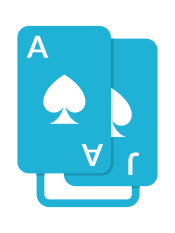
The most powerful hand in the game is called blackjack or a natural. This is a two-card hand consisting of an Ace (counted as 11) and a ten-value card (10, J, Q, or K) for a total of 21. It returns a payout of 3 to 2, although at some tables the payout ratio is reduced to 6 to 5. We explain the difference toward the end of this article. All other winning bets return even money, with the exception of the insurance side bet, which offers a payout of 2 to 1.
The Dealing of the Cards and Order of Play in Blackjack
 The game starts after the dealer shuffles the decks and players position their chips in the betting circles on the layout. Once all bets are placed, the dealer makes two passes, starting with the player at their left side, until everyone at the table has been dealt a starting hand of two cards.
Players have their cards dealt face-up in shoe games or face-down in single-deck and double-deck variations. The dealer always has one card exposed and the other one facing down. The exposed card is commonly referred to as the “dealer’s upcard,” whereas the one facing down is called the “hole card.” There are blackjack variations where no hole cards are in play, but these are common across Continental Europe and Great Britain.
Please keep in mind that you are not allowed to touch your cards in blackjack variations that utilize multiple decks. There is really no need for you to handle the cards, as you can easily see their values because they are already exposed. This is not the case in hand-held variations that use one or two decks only, where players receive their two starting cards face-down and obviously need to pick them up to see their values.
The player positioned immediately to the dealer’s left is the first person to act on their hand, having a choice from hitting, standing, doubling, splitting, accepting insurance, or surrendering. We shall explain these player decisions in further detail in the next section.
Order of Play in Blackjack Additional TipsThe player positions at the blackjack table borrow their names from the game of baseball. Thus, the position of the first player sitting to the left of the dealer is called “first base.” The term “shortstop” refers to the playing position in the very middle of the table, whereas the last seat at the far right end is called “third base” (or “anchor” in some cases).
There is a widespread tendency among recreational blackjack players to pick and choose their seats, but the truth of the matter is your playing position makes no difference from a mathematical perspective.
It is essential for blackjack players to indicate how they want to act on their hands by using specific hand gestures. This prevents misunderstandings and enables surveillance to track the game in case any disputes occur at the table. After all players have acted on their hands, the dealer flips over their hole card, completes their hand, and settles winning and losing bets.
Player Decisions
 Once everyone has received their starting two cards, players have a choice from several decisions, with hitting and standing being the most common options. Hitting means you are requesting additional cards from the dealer when you are not satisfied with the total of your starting hand. There are two hand signals for hitting: tapping the table in multiple-deck games or scratching the felt with your cards in hand-held games.
The second most common decision in blackjack is standing, when the player declines additional cards because they either believe their total is strong enough to beat the dealer’s or fear they will bust on the next hit. In shoe games, you signal a stand with a horizontal waving motion over your cards. In hand-held games, you simply tuck your cards under your chips without exposing their values.
Doubling down is among the most profitable playing decisions in blackjack, but it is possible only on starting hands consisting of no more than two cards. It requires you to double your original stake, although some casinos allow players to double for less than their initial bet. You receive only one additional card afterward.
Doubling down gives you value in certain situations only, particularly those when the dealer exposes a weak card like a 5 or a 6 and you have a starting total of 10 or 11, for example.
Shoe-game dealers place the extra card perpendicularly to your starting two cards to indicate a double-down and prevent confusion. Their colleagues who deal pitch games (as hand-held blackjack is commonly referred to) indicate double downs by tucking the extra card face-down under your chips.
Splitting is possible only when the player is dealt a pair consisting of two cards of equal numerical value (like A-A), although there are variations in splitting rules at blackjack tables around the world. You are again required to post an additional bet that equals your initial wager.
Player Decisions Additional TipsThe signal for splitting in pitch games is tossing your cards face-up next to your chips and placing the additional matching bet next to your initial wager. In shoe games, the player signals a split by raising their index and middle fingers so that they form the shape of a V.
The dealer splits your starting two cards into two separate hands of one card each. You play the hands one after the other as you normally would. Like doubling down, splitting can also be beneficial to the player when done with specific pairs like A-A and 8-8, for instance. If you split pairs of ten-value cards or Aces and reach a total of 21 on the very next hit, this will count as a regular 21 instead of a blackjack, so you will receive an even-money payout.
Recreational players are discouraged from splitting ten-value cards. This decision is reserved only for skilled players who have mastered card counting. Resplitting pairs is permitted as well, but this largely depends on which variation of the game you are playing.
Surrendering a hand is also an option in some blackjack variants, which is basically the equivalent of folding in poker. A blackjack player can execute the surrender option only before they have drawn any additional cards to their starting hand.
The most common variation of this rule is the late surrender, where the player can forfeit their two-card hand only after the dealer peeks for a natural when exposing an Ace. While there is no standardized signal for the surrender decision, it is important to remember that you get only half of your bet back when you execute this play.
When the dealer’s upcard is an Ace, they will offer you insurance. This is a proposition wager and, as such, it requires you to post a side bet that amounts to half of your initial bet. The chips for these side bets are placed in the stripe on the felt that reads “Insurance.”
After you have accepted or declined insurance, the dealer will check their hole card for a blackjack. If the dealer does not have a ten-value card next to their Ace, they will collect your side bet, and play will continue as usual.
Provided that the dealer indeed has a natural, you will lose your initial wager (unless you have a natural as well), but the insurance side bet will earn you a payout of 2 to 1. So, in essence, you break even. The insurance bet is not recommended to casual or basic-strategy blackjack players. First, it gives the house a substantial advantage, and second, it is simply not worth it since there is roughly a 31% chance of the dealer having a natural when their upcard is an Ace.
The Fixed Rules for Blackjack Dealers
 The dealer is always the last person to act on their hand, which helps the house extract a larger advantage from its blackjack tables. When all players have acted on their hands, the dealer reveals their hole card and plays out their hand according to a fixed set of rules determined by the casino. There are no decisions for the dealer to make whatsoever.
In the majority of cases, blackjack dealers are required to hit their hands until they reach totals of 17 or above. For example, if a dealer flips over a 5 next to a 9, they must hit again because their total is 14. When all players at the table bust, the dealer will simply collect their chips and flip over their hole card without hitting their hand, even if its total is under 17.
In some variations, the dealers must hit soft totals of 17 (like 6-A, for example). This rule, abbreviated as H17, gives dealers an additional advantage over players because it allows them to improve their hand with a higher total. To continue with the 6-A example, the dealer can improve their hand by drawing an A, a 2, a 3, or a 4.
Most Common Blackjack Rule Discrepancies
 Unlike most other table games on the casino floor, blackjack does not have a unified system of rules. Therefore, there are major rule discrepancies at different casinos and even at different blackjack tables within the same establishment.
We already tackled the most common discrepancy you are likely to come across, the one concerning the dealer’s standing rules (H17 versus dealers standing on all totals of 17, or S17). As we explained earlier, S17 is the more favorable of the two rules because the likelihood of the dealer outdrawing you is smaller.
There are differences in the payouts for blackjacks as well. It is crucial to pick and choose only tables where naturals return at a rate of 3 to 2. There are variations of the game where you are paid 6 to 5, which is extremely detrimental to players. In essence, you are offered less money for a natural that occurs in only about 4.8% of the hands you play.
To give you an example with actual figures, let’s assume you post a $10 bet and are dealt a natural. If the payout is 3 to 2, you receive $15 on top of your original $10 bet (or 1.5x your stake). A 6-to-5 payout yields net profits of only $12 for an overall return of $22 (or 1.2x your bet). At some tables, players are offered even money (1:1) for their blackjacks.
The number of decks also varies between tables and normally ranges from one to eight decks. The greater the number of decks in play, the higher the house edge gets. Multiple-deck games are more volatile, which means you will experience more significant swings (that is, winning and losing streaks) than you normally would in a pitch game.
Blackjack Rule Discrepancies Additional TipsIn some scenarios, players are also restricted when it comes to their doubling and splitting choices. Some gambling establishments permit players to double down on any two-card total they like, while in others doubling is allowed only on starting hand totals of 9, 10, and 11. This significantly reduces your chances of profiting from situations that would otherwise be beneficial to you.
The same goes for splitting and resplitting pairs. On occasion, you may come across blackjack tables where splitting ten-value cards is possible only if the pair consists of identical cards (like two Jacks or two Queens).
The rules at some tables allow for resplitting Aces, which may also be very beneficial to players, especially to those counting cards. Some casinos will allow you to resplit all other pairs with the exception of paired Aces. Being able to resplit Aces gives you a minuscule advantage of around 0.08%, but it still counts, if you would excuse the pun.
As we mentioned in brief, some blackjack variants do not utilize hole cards, which means there is no way for the dealer to peek for naturals in advance. This is highly detrimental to players in the long term because the dealer receives their second card only after everyone else has completed their hands.
In some multiple-deck games, the dealer peeks for blackjacks on both Aces and ten-value cards. This rule is great because it prevents you from pouring more money (through doubling or splitting) into hands that are automatic losers against the dealer’s natural.
Last but not least, some casinos run tables where the so-called “Charlie” rule applies. In one variation of this rule (yes, there are variations of the rule variations in blackjack), players are awarded an even-money payout when they draw seven cards (a seven-card Charlie) without breaking the hand, that is, without busting. It is irrelevant what the dealer has in this case. On extremely rare occasions, you may come across tables where even-money payouts are awarded for five-card Charlies, but these games have almost become obsolete these days.