

Blackjack is among the best games to play in a casino. Its rules are relatively easy to learn and follow, and, more importantly, players face a house edge of roughly 0.50% when they incorporate perfect basic strategy throughout their betting sessions.
However, one of the most interesting aspects of the game involves the duality of the Ace. The soft hands we are about to explore would be impossible without the Ace, which can be counted as 1 or 11 in blackjack. It is up to the player to decide whether the Ace in their hand counts as 1 or 11.
Hands with an Ace that can be assigned a value of 1 or 11 are called soft and are considered very valuable because the Ace’s duality makes it impossible for the player to bust by drawing another card. This flexibility allows the player to switch the Ace’s value as needed until they reach the desired total against the dealer’s upcard.
However, if you want to take full advantage of soft hands, you need to familiarize yourself with the optimal plays for them; that is, you must know when to hit, stand, or double down on your soft totals. This article introduces you to the correct basic strategy decisions for soft totals 13 through 17. We recommend you pay attention because some of these totals are among the most frequently misplayed hands in the game of 21.
Soft Totals 13 through 16
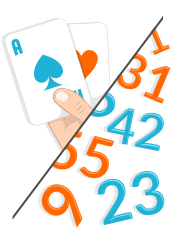 Now that we have explained what soft hands are, let’s look at the correct way to play soft totals of 13 through 16. When players start a round with these totals, they have two options: they can either hit them or double down.
Doubling is viable only when the dealer is at a disadvantage and starts the round with small cards that can cause them to bust. Let’s examine the situations in which the dealer is not weak enough for you to double on your soft 13 through soft 16.
When you are dealt soft 13 (A-2), soft 14 (A-3), soft 15 (A-4), and soft 16 (A-5) and the dealer is not in a breaking position, you should assume your Ace has a value of 1 and hit your hand until you reach a hard total of 17 or higher. Let’s take a moment to consider a concrete example where you hold A-2 against a dealer with an upcard of 3.
You are in a very advantageous situation here because no third card you can possibly pull out of the deck/shoe can bust your hand. The worst that could happen is for you to draw a ten-value card, in which case your Ace’s value will convert to 1 for a hard total of 13. In the best-case scenario, you draw a 7 for a soft total of 20 (which you stand on because it already puts you in the safe zone) or an 8 for an unbeatable total of 21.
When the dealer exposes a particularly weak card that can cause them to bust on the next hit, players should always take advantage of this opportunity and increase their action by doubling on their soft totals 13 through 16. This gives them a small edge against the house.
Since upcards 4, 5, and 6 are the worst cards a dealer can start their hand with, basic strategy recommends always doubling on soft 13 through soft 16 against them. Assume you hold A-4 against a weak dealer with a 5. There are several possible outcomes for you in this instance.
- You pull small cards 4, 5, or 6, which give you nice totals of 19, 20, or 21.
- You draw a 7, 8, 9, or one of the ten-value cards (10, Jack, Queen, or King) and end up with hard totals of 12 through 15.
- You receive an Ace for a 16 (one of the worst totals a player might end up with).
- You draw a deuce for 17 (which, as we explained in the article on soft and hard hands, is still not good enough).
- You receive a 3 for 18.
As you can see, only three cards can get you into the coveted safe zone out of the 13 possible denominations (Ace through King). So why pour more money onto the felt with a soft 15? The reason is simple: blackjack players should seize every opportunity to win more money through doubling down when the dealer is in big trouble with small upcards like 4, 5, and 6. It is mathematically proven that doubling is the best possible play for these soft hands in the long term.
Soft 17: One of the Most Frequently Displayed Hands in Blackjack
 You might think that following a chart showing the correct decision for any possible round at the blackjack table is easy enough, and indeed it is, but this does not prevent some people from misplaying certain hands. Such is the case with soft 17, which ranks among the most frequently misplayed hands in blackjack.
Many inexperienced players assume that they should stand on soft 17 when the dealer starts with a small card that is likely to cause them to bust. Others stand on this soft total regardless of what the dealer’s upcard is because they are afraid to ruin their “good” hand.
The trouble is that soft 17 is not really all that good to begin with. Actually, always standing on it causes players to lose more money in the long term than they do when hitting or doubling on this soft total. Basic strategy players should never stand on soft totals of 17, no matter what upcard the dealer exposes.
You either hit or double with this hand. If you still doubt this is the right course of action, ask yourself this one question: “Why does the house edge increase under the H17 rule for dealers?” This happens because hitting soft 17 is always better than standing, both for the dealer and for the player.
So when should you hit this soft hand? The correct decision here is influenced by the number of decks the blackjack game utilizes. When you are playing double-deck and multiple-deck games, hit your soft 17 when the dealer exposes a deuce or when they have 7, 8, 9, 10, Jack, Queen, King, or Ace.
The optimal play for a single-deck game is almost the same except for one situation: the dealer’s deuce. The player should double on their soft 17 against a dealer showing a deuce in single-deck blackjack.
Soft 17 Additional TipsIt is important to remember that the primary purpose of doubling down is not to try to outdraw the dealer but to increase the money you have on the table when the dealer is most susceptible to busting. This normally is the case when the dealer shows small upcards 3 through 6.
If you are facing one of those upcards in a multiple-deck S17 game and you have a soft 17, you should always double down. The same goes for double-deck blackjack. When playing with a single deck, the correct strategy requires you to double on your soft 17 against dealer upcards 2 through 6. What if your soft 17 consists of more than two cards, like 2-4-A, and it is impossible to double? Again, the best course of action is to take a hit on your soft 17.
The average player misplays soft hands more frequently than any other card combination in blackjack. The result is lots of missed opportunities to turn a profit on hands that allow much more room for error. It is impossible to bust on the next hit when you have a soft holding because of the flexibility the Ace gives you. The bottom line is that if you have taken the time to master the correct strategy plays for soft hands 13 through 17, you are already on your way to becoming a more profitable blackjack player.