Rookie blackjack players often wonder whether their seat position affects their odds of winning, and we address this subject in today’s article. There is no single answer to this question because the relevance of where you sit at the blackjack table depends on whether you play basic strategy or use more advanced techniques like card counting.
This topic has been hotly debated for years, giving rise to various superstitions and plenty of misguided advice. Some players avoid certain seats like the plague because they are convinced those positions bring bad luck.
Others avoid particular seats because they fear fellow players will blame them for ‘taking the dealer’s bust card’ and causing the entire table to lose the round. So is there any truth to these sentiments, and does seat position matter in blackjack? Stay with us to find out. First, we will review the terminology for table positions in blackjack.
Key Positions at the Blackjack Table
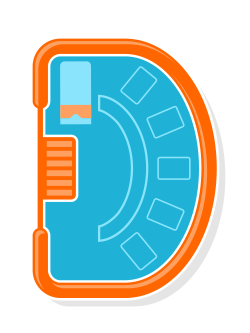 Live blackjack tables typically have a semicircular shape and can accommodate up to seven seated players, although most live dealer variants allow you to bet behind (that is, to wager on other participants’ hands) when there are no vacant seats.
There are three key positions at the blackjack table, and all of them borrow their names from baseball. Those three seats in relation to the dealer are as follows:
To our knowledge, there is no specific terminology for the other positions, even though blackjack tables can accommodate more than three players at a time.
Other Players’ Decisions Have No Impact on Your Odds
Some people mistakenly assume that the decisions of players seated at first base or third base can affect the odds for the entire table. They believe the first base sets the tone for any given round, while poor decisions from third base may increase the dealer’s chances of winning.

An Example of Rookies ‘Messing Things Up’ for the Entire Table

Software Simulations Proof

Confirmation Bias Is Common among Gamblers

How Table Position Can Help Basic Strategy Players
An Example of Rookies ‘Messing Things Up’ for the Entire Table
Timid, inexperienced players commonly avoid these seats because they fear their decisions will provoke the ire of the entire table. Suppose a rookie misplays a hard 13 against the dealer’s 6, deciding to hit rather than stand as basic strategy recommends. The rookie draws a ten and busts.
The dealer then flips over another ten for a hard 16, hits, and receives a five for a total of 21, outdrawing all unbusted players at the table. Everyone turns on the rookie, blaming them for the collective loss. Had this novice simply stood, as basic strategy dictates, they would not have taken the dealer’s bust card, right?
Software Simulations Proof
Incorrect. The truth is that the poor playing decisions of fellow patrons have no bearing on your long-term odds of winning. Various software simulations, including one conducted by gaming expert and analyst Michael Shackleford, better known as the Wizard of Odds, have proven that this line of reasoning is wrong.
Shackleford ran a computer simulation on a standard US-style blackjack variation that offered the following playing conditions:
- 6 full decks in play
- The dealer must stand on soft 17
- Players can double on any initial card total
- Doubling down after splits is permitted
- Players have the option to surrender late
- Resplitting is possible to a maximum of four hands
The gaming expert tuned the software so that it simulated two people who played strictly in line with basic strategy during the first 1.6 billion hands. As it turned out, they both finished with approximately the same negative expected value (EV), regardless of who acted first.
- Basic strategy player A recorded a negative EV of -0.289%
- Basic strategy player B had a negative EV of -0.288%
A second simulation was then run, this time over roughly one billion hands, where player A continued to use perfect basic strategy, while player B, who was second to act, deviated from it in the following ways:
- Player B split all pairs
- Player B never took advantage of the late surrender option against solid dealer upcards
- Player B never doubled down on any soft starting totals (like soft 15, soft 16, and soft 17 against the dealer’s 5 or 6)
- Player B doubled down on starting totals 9 through 11 no matter what upcard the dealer exposed
- Player B hit all hard totals of 12 through 16
Anyone with even a rudimentary knowledge of blackjack basic strategy would immediately recognize that these are very poor playing decisions.
If other players’ bad moves truly affected the table’s overall odds, player A’s EV would have declined significantly, right? The results of this second simulation say otherwise.
- The expected value of player A remained virtually the same at -0.28%.
- Player B’s nonsensical decisions led to a considerable decline in his own expected value, dropping it from -0.29% to -11.26%.
As the two simulations clearly indicate, patrons only hurt themselves when they misplay their hands. Right or wrong, their decisions do not reduce the long-term expectation of the entire table, despite what some players believe.
Confirmation Bias Is Common among Gamblers
A bad play can just as easily help the table because basic strategy players have no knowledge of the composition of the cards still to be dealt. Their decisions are based solely on their starting totals and the denomination of the dealer’s exposed card.
To revisit the earlier example, suppose the cards were reversed. The rookie at third base again hits a hard 13 against the dealer’s 6 but this time draws a 5 for a total of 18.
The dealer would then draw the 10 to her hard 16 and bust, and the entire table would rejoice at her loss. Few players, however, would congratulate the third-base rookie for “saving” the table with his incorrect decision.
This is a classic example of confirmation bias, which many uninformed gamblers exhibit. People tend to search for, interpret, and remember mainly the information that validates their existing beliefs. Our minds often highlight data that confirms our views and ignore the rest.
How Table Position Can Help Basic Strategy Players
Table position matters to recreational players only insofar as they have mastered basic strategy. If you are just learning the correct plays, sitting at third base or near it (seats №5 or №6, for example) gives you a slight advantage because you will have more time to analyze your total against the dealer’s exposed card before you make a move.
Taking the first-base seat has the opposite effect. First-base players are expected to act on their hands immediately after the initial deal, leaving less time for analysis.
Making decisions in a hurry, especially when you lack experience, could lead to more playing errors and lower your expectation.
Table Position Is Relevant for Card Counters Only
Seasoned basic strategy players should have no issues regardless of which seat they occupy at a live table. Seat position matters only to advantage players who know how to count cards.

Counters Get More Information from Third Base

Glimpsing the Dealer’s Hole Card from First Base
Counters Get More Information from Third Base
Some card counters prefer to sit at third base because this position allows them to gain more information about the composition of the remaining cards. Seeing the hands other players receive enables advantage players to make slightly more informed decisions. Additionally, this seat makes it easier to keep track of the cards compared with the shortstop seat, for example. You get a clear view of everyone’s hands without having to constantly move your head left to right to see the other dealt cards. Scanning the table back and forth is a telltale sign of counting and could get you into trouble with management.
That said, your position makes no measurable difference from a mathematical standpoint in terms of expected value when you play shoe games dealt from multiple decks. Being the last to act while counting cards slightly improves your expectation in double-deck blackjack, adding 1% to 2% to your EV.
A word of caution, though. Seasoned dealers, floor managers, and pit bosses know that advantage players favor the third-base spot and tend to keep a close watch on this position. If you count cards, consider sitting elsewhere to avoid unwanted scrutiny and potential detection.
Glimpsing the Dealer’s Hole Card from First Base
Because of the higher risk of detection associated with third base, some savvy counters prefer the first-base seat. They can sometimes catch a glimpse of the dealer’s hole card from this position if they are careful, and this knowledge gives them a decisive advantage.
Rookie counters are often more comfortable at first base because they can partially control the pace of the game. The dealer must wait for first base to act before moving to the next player, giving novice counters enough time to correctly update their running count.
A rookie counter in the third-base seat is more susceptible to counting errors. Suppose the first-base player hits immediately after the initial deal, busts, and loses. The dealer would remove that player’s cards right away, and the novice counter might fall behind on the running count, committing costly mistakes as a result.
To sum up, from a mathematical standpoint it makes very little difference where you sit, even if you count cards. There are more effective ways to improve your long-term expectation through advantage play, such as accurate running-to-true-count conversion, proper bet sizing relative to the count, and using playing deviations to maximize your edge against the house.