

Card counting is an advantage-play technique that allows skilled blackjack players to gain a long-term edge over the house. It involves tracking the ratio of high to low cards as they are dealt, assigning value tags to the different card denominations. A surplus of high cards favors the players, while an abundance of low cards benefits the dealer.
The technique is not as difficult to master as the uninitiated think. Contrary to popular belief, card counters do not have to memorize every card that has been dealt, nor must they be autistic savants like Dustin Hoffman’s character in Rain Man.
The only qualities required for mastering this technique are patience, discipline, tenacity, and some basic arithmetic skills. Any committed blackjack player can learn to count cards, but most fail to generate long-term profits because they make far too many blunders at the tables.
Today, we will discuss the most common mistakes rookie counters commit. Check them out if you are new to card counting, as they may ultimately make the difference between losing and winning in the long run.
Mistake #1 - Using a Very Complicated Counting System
Card counting gained notoriety in the early 1960s when mathematician and blackjack researcher Edward Thorp introduced the first point count system in his groundbreaking book Beat the Dealer. Many card-counting systems have appeared since then, and blackjack experts usually group them into four main categories: Level I, Level II, Level III, and Level IV.
| Card Value | Hi-Lo | Hi-Opt II | Wong Halves | Red Seven | Revere 14 Count |
|---|---|---|---|---|---|
| Ace | -1 | 0 | -1 | -1 | 0 |
| 2 | 1 | 1 | 0.5 | 1 | 2 |
| 3 | 1 | 1 | 1 | 1 | 2 |
| 4 | 1 | 2 | 1 | 1 | 3 |
| 5 | 1 | 2 | 1.5 | 1 | 4 |
| 6 | 1 | 1 | 1 | 1 | 2 |
| 7 | 0 | 1 | 0.5 | 0 or +1* | 1 |
| 8 | 0 | 0 | 0 | 0 | 0 |
| 9 | 0 | 0 | -0.5 | 0 | -2 |
| 10, K, Q, J | -1 | -2 | -1 | -1 | -3 |
| Level | Level I | Level II | Level III | Level I | Level IV |
| Balanced/Unbalanced | Balanced | Balanced | Balanced | Unbalanced | Balanced |
*The Red Seven system keeps a side count of the sevens. Sevens of diamonds and hearts count as +1, whereas the sevens of clubs and spades count as 0.
 Complex Systems Are More Efficient
 Complex System Could Result in More Errors
 Stick to the Good Old Hi-Lo
Mistake #2 - Messing Up the Running Count
1Overview
Professional blackjack player Don Johnson famously said, “Monkeys can count cards.” Yet, as easy as learning to count may seem, players still need proper preparation before they can apply it effectively. In a noisy casino environment, rookies often struggle to maintain a running count and convert it to a true count.
It is not uncommon for novice counters to make costly running count (RC) errors, ultimately preventing them from becoming winning players. Keeping an accurate running count is essential if you want to beat the house at its own game. Below are three of the most serious RC mistakes you can make while counting cards at the blackjack tables.
2You Forget to Update the Running Count
Forgetting to update the running count while you play out your hand is a major mistake that can cost you dearly in the long run. You must keep an accurate RC at all times, accounting for every card that leaves the shoe, or you are doomed to fail.
Updating the RC is the first thing you should do after a card hits the felt. Do it before you add up your hand total, before you consider a basic-strategy move, and before you celebrate with fellow players after the dealer busts.
3You Miscount the Dealer’s Exposed Card
Another common way novices mess up the running count is by miscounting the dealer’s exposed card. This can happen in several ways, and all of them can erase your positive expected value over time. Some rookies completely forget to count the dealer’s exposed card.
Others count it twice: once after the initial deal and again after the dealer flips over the hole card to complete their hand. Either way, this error must be eliminated as early as possible. Remember to count each card that hits the felt no more than once.
4Mistaking One Card Denomination for Another
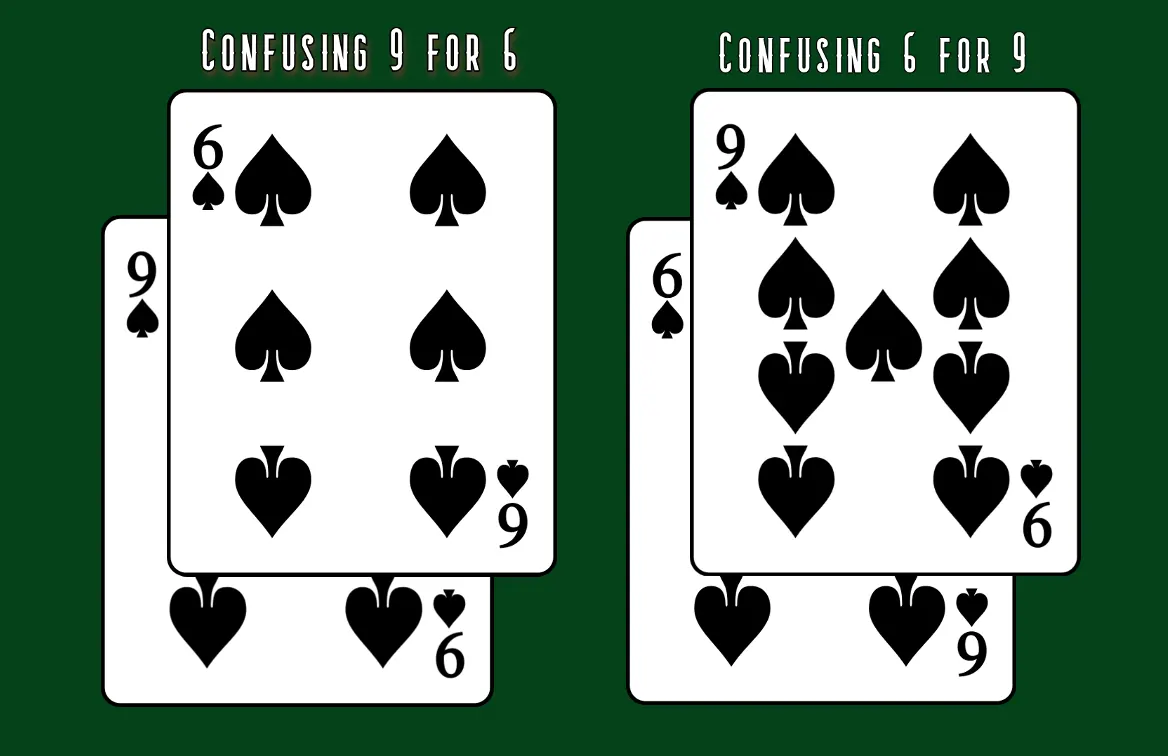
As strange as it may sound, novices sometimes ruin the running count by confusing one card denomination for another. This usually happens with 9s and 6s when players track them by looking at the bottom corner of the cards. From this angle, the two denominations are reversed at the bottom, making them easy to mix up.
Mistake #3 – Counting Games with Poor Playing Conditions
 Savvy players always familiarize themselves with the playing conditions a given table offers before they take a seat. We have heard some counters argue that they play subpar games due to a lack of choice, as there are no casinos with friendlier conditions nearby.
However, we consider this a flimsy excuse, as the main (or should we say the “only”) purpose of card counters is to generate positive expected value.
If the conditions in your local casinos prevent you from doing this, you will be better off not playing at all. Otherwise, you are just throwing your money away with both hands. Smart players will never settle for the rules we list below:
- No doubling after splitting pairs
- No doubling on soft hands
- Doubling only on two-card totals of 9, 10, and 11
- Splitting only once to a maximum of two hands
- The dealer hits soft 17 rather than standing
- Even money payouts for blackjacks
- 6 to 5 payouts for blackjacks
- Insufficient shoe penetration
Mistake #4 – Confusing True Count with Running Count
 This is another widespread mistake among rookie counters who have not practiced sufficiently before attacking the tables in a real casino environment. As is to be expected, this blunder has a devastating effect on their long-term expected value.
If you are reading this, you probably already know the difference between the running count and the true count, but we will review it briefly for those who do not.
You make playing and betting decisions based on the true count, and you should never confuse it with the running count. Here is how such a mistake unfolds, and we assure you the consequences will not be pretty. The example below comes from a six-deck blackjack game.
Mistake #5 - Overbetting and Underbetting
Finally, we arrive at the subject of bet sizing and wagering in proportion to your bankroll. It is important to note that both overbetting and underbetting are equally detrimental to an advantage player.
 Overbetting Your Bankroll
 Underbetting Your Bankroll