
Online casinos offer dozens of enticing blackjack variations, but not all are created equal. Some provide less favorable playing conditions than others, significantly reducing players’ odds of winning in the long run. Their poor rules go hand in hand with higher house edges that can drain your blackjack bankroll the longer you play.
When it comes to gambling, there is one rule of thumb: the greater the house edge, the more money players stand to lose and, conversely, the more casinos will profit.
In the following article, we share some of the worst blackjack games you can find at online casinos. You might want to avoid them if you wish to improve your winning chances and lose less over time.
Blackjack Rule Variations Players Should Generally Avoid
 Blackjack is arguably the best game you can play at online casinos because it carries an almost negligible house advantage of approximately half a percent. It is worth noting this percentage can increase depending on one’s skill level.
Players who follow their gut instincts rather than using blackjack basic strategy typically face a higher house edge of around 2%, sometimes even more. Basic strategy reduces your disadvantage because it tells you when it is optimal to hit, stand, double down, or split.
Assuming you have already mastered basic strategy, the first thing you should do before you start playing online blackjack for real money is to check the rule set. This is because rule variations in blackjack have an impact on players’ overall expected return in the long term.
Some rules will improve your expected value, while others work in favor of the casino. Below, we list some of the most common rules that boost the statistical advantage of the house and reduce the long-term profitability of basic strategy players. The percentages denote the corresponding increase in house edge.
- +0.09% if doubling down is allowed only on hard totals of 9, 10, and 11.
- +0.18% if doubling down is allowed only on hard totals of 10 and 11.
- +0.11% if the dealer is not dealt a hole card. This is often the case in variations that follow the European rules.
- +0.10% when hole cards are in play but the dealer never peeks to check for potential blackjacks when showing a ten. This rule is detrimental because players can lose all their wagers, including those from double downs and splits, if the dealer ends up with a blackjack.
- +0.10% when resplitting is disallowed.
- +0.14% when doubling down on split hands is prohibited.
- +0.18% if splitting aces is prohibited.
- +1.39% if blackjacks pay at reduced odds of 6 to 5.
- +2.27% if blackjacks pay even money (1 to 1).
- +0.22% when the dealer must draw on soft totals of 17.
- +6.91% when the dealer pushes with the player on totals of 22 instead of busting.
Now that you know which rule variations are generally detrimental, let’s examine four of the worst blackjack variants that we found at online casinos. All of them produce house edges exceeding half a percent and offer poor rules that decrease players’ long-term theoretical returns. These games will cost you far more money than blackjack variants with friendlier rules.
Free Bet Blackjack by Evolution Gaming - the Worst of the Bunch
This blackjack variation debuted in Las Vegas casinos about a decade ago. It later became available at many live dealer casinos after Evolution Gaming adapted it for online play in 2019.
The main feature of this variant is that it allows players to double down or split their hands at no cost. Sounds great, right? Well, we hate to break it to you, but there is a catch, and it almost triples the house edge.
 Rules of Play in Free Bet Blackjack
 Expected Return in Free Bet Blackjack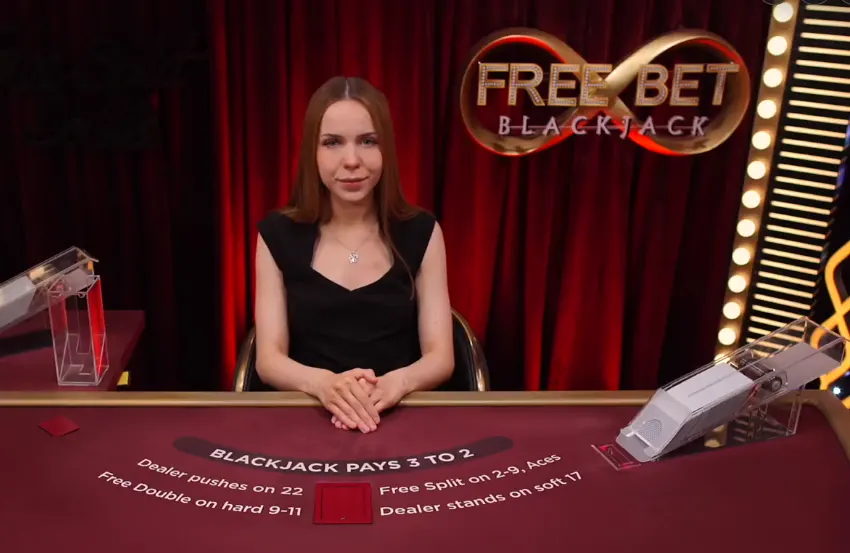
Double Exposure
1Overview
Double Exposure is a unique blackjack variation, also known as Face Up 21 or Dealer Disclosure. The game is available at numerous land-based casinos in gambling hubs such as Reno, Atlantic City, and Las Vegas. It has also transitioned to the virtual realm thanks to software suppliers like Play’n GO and Pragmatic Play, which have adapted it for online play.
2Both Dealer Cards Are Exposed but at What Cost?
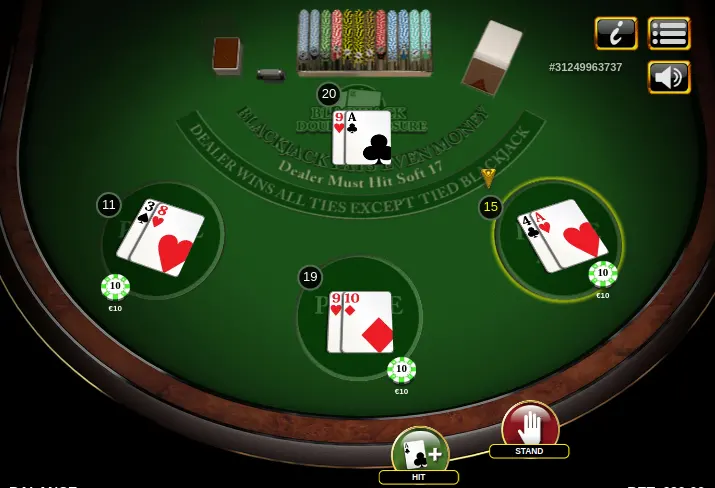
As the name suggests, both of the dealer’s cards are dealt face up so players can see them before making any decisions. While this sounds appealing, other changes offset the huge advantage this information would otherwise give. Truth be told, Double Exposure combines some of the worst rules you can find in blackjack.
3The Dealer Takes All Ties Bar Tied Blackjacks
To begin with, the dealer wins all ties, which significantly tips the scales in the house’s favor. The only exception is when both the dealer and the player have blackjacks, in which case the player’s natural wins.
4Blackjacks Pay Even Money
What makes matters worse is that blackjacks pay reduced odds of 1 to 1 instead of the standard 3 to 2. Most of the remaining rules also work against the player. Play’n GO’s version, in particular, includes the following conditions. You will notice many of the detrimental rules we discussed earlier on this list.
- Six decks are reshuffled after every round.
- The dealer must stand on all totals of 17.
- Players cannot resplit.
- Split aces receive only one additional card.
- Doubling down is possible only on hard totals of 9, 10, and 11.
- Players cannot double down after splitting.
- Two-card totals of 21 after splitting count as regular 21 rather than blackjacks.
- Players cannot buy insurance for obvious reasons.
5Pragmatic Play’s Version Is Worse
As hard as it is to believe, some online versions of Double Exposure offer even poorer rules than those described above. This is the case with Pragmatic Play’s rendition, where you can play up to three betting spots at once. The expected return to player is even lower, as you will see shortly.
- Pragmatic’s version uses 5 standard decks.
- The dealer must draw to soft 17.
- Surrendering, resplitting, and hitting split aces are not allowed.
- Players cannot split unlike ten-value cards, e.g., K/J, 10/Q, J/Q.
- Doubling down is allowed only on 9, 10, and 11, including on soft totals.
- Players can double down after splitting pairs.
All other rules match those in the Play’n GO version, meaning the dealer wins all ties except tied blackjacks, and naturals pay reduced odds of 1 to 1. The only favorable rule featured in this version is that players may double down after splits.
6BGaming’s Version Has the Best Odds
The younger software studio BGaming released its version of Double Exposure in early 2018, and surprisingly, it offers the lowest house edge of all the variations discussed so far. Most of the rules match those in the Play’n GO version; the only difference is that eight full decks are in play instead of six.
7Expected Return in Double Exposure
The expected return for Double Exposure is subpar compared with standard blackjack, where you get to see only one of the dealer’s cards. The combination of the dealer taking ties, even-money payouts on blackjacks, and restrictive doubling and splitting rules pushes the house edge to nearly one percent in Play’n GO’s variation.
| Theoretical Return and House Edges in Double Exposure | ||
|---|---|---|
| Software Supplier | Theoretical Return | House Edge |
| BGaming | 99.30% | 0.70% |
| Play’n GO | 99.04% | 0.96% |
| Pragmatic Play | 98.80% | 1.20% |
If you insist on playing Double Exposure, we recommend the variation developed by BGaming, as it carries the lowest house edge (0.70%) of the three. On average, you will lose ¢0.70 for every hundred dollars wagered.
Pragmatic Play offers the most expensive version; players can expect long-term theoretical losses of $1.20 for each hundred dollars they risk. Play’n GO’s version is slightly better, as you will lose just under a dollar per hundred dollars wagered.
Note that the return percentages above are accurate only if you use perfect basic strategy for Double Exposure. That strategy differs greatly from the one for conventional blackjack, where decisions are based solely on your total and the value of the dealer’s upcard.
Super Fun 21
Over the years, multiple software suppliers have created variations of this intriguing game, including major names such as Playtech, Microgaming, RTG, and OpenBet. One of the latest versions, Super Fun 21 Extreme, is produced by Scientific Games.
Despite its appealing name, Super Fun 21 is not the best blackjack variation when it comes to winning odds. The game is deceptive, as it offers many liberal, player-friendly rules, but their benefits are completely offset by the reduced payouts on blackjacks.
 Super Fun 21 Extreme by Scientific Games
 Expected Return in Super Fun 21
Zappit Blackjack - Brought to You by the Creator of Blackjack Switch
1Overview
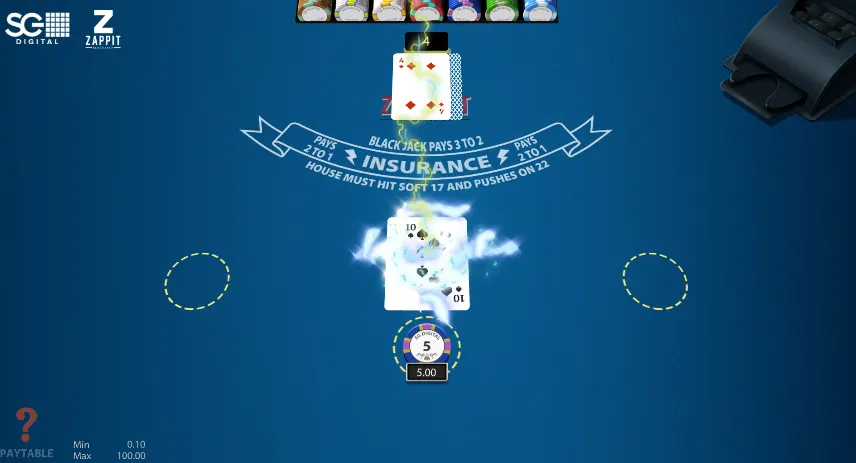
Fans of unconventional blackjack variations may be familiar with Geoff Hall. Arguably the most popular game inventor in the gambling industry, Hall created a unique 21 variant called Zappit Blackjack, which he later sold to Scientific Games.
2Players Can Swap Hard 15 through Hard 18
Zappit Blackjack’s biggest claim to fame is that it allows players to swap their initial two cards for new ones when the original total is a hard 15 through 18. “Where’s the catch?” you might ask. The house pushes with all unbusted player hands, except blackjacks, when the dealer reaches 22. The following rules are also in place:
- The game uses six standard packs of cards.
- The dealer hits soft 17 and pushes on 22.
- Blackjacks pay the standard 3 to 2.
- Doubling down is available on all two-card totals.
- Players can split only once to form two hands.
- Hitting split aces is not allowed.
- Players cannot zap a hard 15 to hard 18 after taking any other action on the hand.
- Players may zap before the dealer checks for a blackjack.
- If a blackjack results from zapping, the payout is even money rather than 3 to 2.
3Expected Return in Zappit Blackjack
Zappit Blackjack is not as punishing as some of the variants discussed earlier, but it still carries a house edge of more than one percent because of the “Dealer push on 22” rule. The casino’s long-term advantage stands at 1.13%, meaning players can expect a theoretical return of 98.87%.
With a house edge this high, Zappit Blackjack is far from your best option, although it still offers better odds than games like roulette. The ability to swap your initial cards when holding certain hard totals simply costs too much. As intriguing as it is, your wallet will not appreciate this blackjack variation.
Hall also designed Blackjack Switch, which is available at some Playtech online casinos. In that game, you play two hands simultaneously and may swap the top cards to improve your totals. We recommend Blackjack Switch over Zappit Blackjack because it carries a very low house edge of just 0.15% with perfect strategy.