
Blackjack is a casino game based on conditional probability, which is precisely what makes it beatable. This means that what happened in the past affects the probability of what will happen in the future. Once a given card is dealt on the blackjack table, it cannot appear again until the dealer finishes the deck or shoe and reshuffles.
If you take a single deck of cards and pull out the Ace of hearts, for example, you cannot draw it again until you reintroduce it into the pack. This peculiarity of blackjack renders it susceptible to advantage play techniques such as card counting.
Card counters use systems that allow them to keep track of the cards that have already been removed from the deck or shoe. This gives them an accurate idea of which cards remain to be played before the reshuffle. Card counters capitalize on shoes that are rich in favorable cards by placing larger bets. Conversely, when the remaining cards favor the house, smart players reduce the amounts they wager because they are at a disadvantage.
Card counting is not as complex as it appears. There is no need to memorize the exact order in which the cards are dealt, as many people seem to think. You simply keep track of the ratio of high to low cards. To achieve this, you need to use a card counting system. There are many card counting systems out there, but what are the differences between them, and which one should you choose?
Classification of Card Counting Systems in Blackjack
 Before we discuss the classifications, we should answer the question “Why are there different card counting systems to begin with?” The main reason is different systems attempt to solve different problems.
Some systems are quite easy to learn and use, but they are not as effective in pitch games. Others yield higher efficiency at the single-deck and double-deck tables but are not as effective or simple to use in shoe games with multiple decks. Card counting systems can be classified on the basis of three main criteria: balance, level, and side counts. Let’s take a look at balanced and unbalanced systems first.
Balanced vs. Unbalanced Card Counting Systems
 Card counting systems are either balanced or unbalanced. The most popular example of a balanced system is the Hi-Lo, which is the system of choice for many professional blackjack players. Balanced systems like the Hi-Lo always start and end at zero.
If you take a standard deck and go through every single card in it, you will inevitably arrive at a running count of zero after you pull out the last card. If you arrive at any other number in the end, you have most certainly made a mistake in the running count.
This is not the case when one uses an unbalanced counting system. Unbalanced systems like Red Seven and KISS, for example, can start with a value other than 0 and have pivot points that indicate when the card counter must adjust the size of their bets.
Balanced vs. Unbalanced Card Counting Systems Additional TipsBalanced systems are preferred by many professionals because they yield higher accuracy. Unfortunately, increased efficiency inevitably comes at the expense of higher complexity. Players who use balanced systems adjust their bet size in accordance with the count. They must keep an accurate running count, which is converted into a true count at a certain point.
The player should also memorize the correct deviations from basic strategy and spread their bets in accordance with the true count. Apart from division, the player should be able to accurately determine the number of decks that are left in the shoe in order to perform the conversion from running to true count.
Unbalanced systems do away with deck estimation and division. The player starts with what is called an Initial Running Count (IRC) and keeps it up until they reach the pivot, which indicates the odds have shifted in their favor. The player again builds up an edge on positive counts. There are fewer calculations to perform with unbalanced counting systems, but they are not as accurate or effective as the balanced ones.
Single-Level vs. Multi-Level Card Counting Systems
 Card counting systems can also be classified on the basis of their level. Players who use single-level systems assign values of +1, -1, or 0 to the cards as they keep a running count. The Hi-Lo is a single-level counting system in which high cards such as Ace, 10, King, Queen, and Jack are assigned a value of -1 because they favor the player, and low cards from deuce through six are counted as +1 because they favor the house. Cards with denominations of 7, 8, and 9 are considered neutral and, as such, have no value, i.e., they are counted as 0.
Another popular example of a single-level system is Hi-Opt I, where cards with denominations of 2, 7, 8, 9, and Ace are neutral and have a count value of 0. Small cards 3, 4, 5, and 6 are detrimental to the player and again have a count value of +1, whereas only the 10s and face cards are counted as -1.
Things get more complex when one introduces additional count values to certain cards, as is the case with multiple-level systems like the Zen Count. This is a level-2 system that was introduced by blackjack authority Arnold Snyder in his 1983 book Blackbelt in Blackjack.
Single-Level vs. Multi-Level Card Counting Systems Additional TipsThere is a second count value in this system since cards 2, 3, and 7 are counted as +1, cards 4, 5, and 6 are counted as +2, the 10s and face cards are assigned a value of -2, and the Aces are counted as -1. The 9s and 8s are again neutral and are counted as 0. Introducing a second count value obviously increases the complexity of such systems, yet they yield more accurate and efficient results.
Keep in mind there are also level-3 and even level-4 systems, but these are better left to the most experienced players. The efficiency of these systems drops dramatically when you make mistakes. Those who are new to card counting should stick to simpler, single-level systems like the Hi-Lo.
Systems with Side Counts for Aces
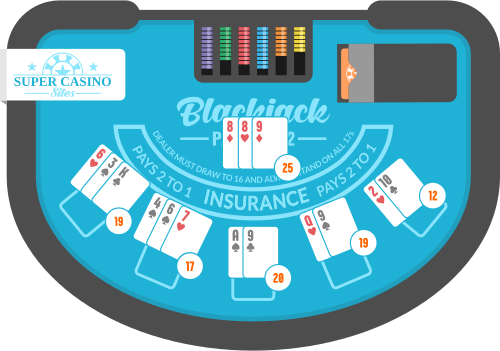 You may have noticed from the previous section that more complex, multi-level systems like the above-mentioned Zen Count enable players to keep a side count of the Aces that have been dealt in addition to keeping a running count.
It makes sense that side-counting Aces adds to the system’s complexity because you have to keep track of several things simultaneously. However, being able to side-count Aces is very valuable, because the effect of removing these cards is the most dramatic. The Ace is easily the most valuable card in this game. Without it, there would be no blackjacks that yield higher payouts of 3 to 2. Thus, side-counting Aces allows you to make more accurate decisions about the insurance bet.
Blackjack Card Counting Gameplay
Factors to Consider When Choosing a Counting System
 When choosing a system, aspiring card counters should take into consideration several important factors.
These include the system’s playing efficiency (abbreviated as PE), its betting correlation (BC), and the insurance correlation (IC).
It makes sense that your experience level should also impact your decision. If you are an aspiring card counter, it would be best to start with a simpler system that allows you to keep accurate track of the cards.
The Betting Correlation
 The betting correlation shows players how efficient a given card counting system is at identifying advantageous betting situations. When the sum total of all possible permutations of the cards that remain to be dealt gives you positive expectation when you play optimally, making a bet also offers a positive expected value. The higher the betting correlation of a given system, the better. A system with a high betting correlation assigns count values that are very close to the actual effect of removing the cards.
The Playing Efficiency
 The playing efficiency of a given card counting system tells you how effective the system is at determining the deviations from basic strategy. This is very important for professional blackjack players because a portion of their expected returns comes from departing from basic strategy based on the composition of the remaining cards.
In other words, PE measures how efficiently a counting system informs you to adjust your strategy in accordance with the composition of the undealt cards. The higher the playing efficiency of the system, the better the results it yields.
The Insurance Correlation
 Another portion of the expected profits for blackjack players comes from correctly identifying the situations when accepting insurance becomes a positive-expectation bet. This happens during high positive counts when the shoe is rich in ten-value cards. The dealer is more likely to have blackjack under these conditions.
It makes sense that card counting systems that keep side counts of the Aces are more efficient at identifying the situations when the player needs to take insurance. Insurance correlation affects both the betting correlation and the playing efficiency of the systems. Keeping a side count of the Aces improves the betting correlation because these are the most valuable cards from a betting perspective. At the same time, side-counting Aces leads to a decrease in playing efficiency because these cards can have a value of either 1 or 11.
It also matters what type of tables one is playing, since playing efficiency is more important in pitch blackjack while betting correlation has more value in shoe games. It follows that keeping a side count of the Aces is more important when you play multiple-deck blackjack dealt from a shoe.
Some players keep side counts of other cards besides the Aces to improve their overall playing efficiency. This requires a good deal of experience, practice, and concentration because complexity increases exponentially with each side count you add. Check the table below for the precise betting correlation, playing efficiency, and insurance correlation of the most commonly used card counting systems.
| Counting System | System Type | Betting Correlation | Playing Efficiency | Insurance Correlation |
|---|---|---|---|---|
| Hi-Lo | Balanced | 0.97 | 0.51 | 0.76 |
| Red Seven | Unbalanced | 0.98 | 0.54 | 0.78 |
| K-O | Unbalanced | 0.98 | 0.55 | 0.78 |
| KISS 1 | Unbalanced | 0.87 | 0.58 | 0.81 |
| KISS 2 | Unbalanced | 0.9 | 0.62 | 0.87 |
| KISS 3 | Unbalanced | 0.97 | 0.56 | 0.78 |
| Omega II | Balanced | 0.92 | 0.67 | 0.85 |
| Hi-Opt I and II | Balanced | 0.88/0.91 | 0.61/0.67 | 0.85/0.91 |
| Zen Count | Balanced | 0.96 | 0.63 | 0.85 |
| Wong Halves | Balanced | 0.99 | 0.57 | 0.72 |
The Insurance Correlation Additional TipsIt is up to you to decide which system to use. Keep in mind that if you choose to count with a balanced system, you will have to perform division accurately as you convert the running count to the true count. If you struggle with this calculation, it may be better to pick a simpler unbalanced system that relies on a pivot number to indicate modifications in bet size.
Note that unbalanced systems like the K-O may be simpler to use, but they are not as efficient in pitch games, especially in comparison to balanced systems like the Hi-Lo. Complex systems such as Wong Halves and Hi-Opt II are naturally more powerful, but there is more room for errors with them.
You cannot expect to count perfectly when your brain is overtasked and fatigued, not to mention that mastering such systems requires much more time and effort. At the end of the day, you decide which system works best for you. Our advice is to choose one that gives you a good balance between efficiency, versatility, and ease of use.