
Kenny Rogers once sang that in poker, as in life, one must “know when to hold ’em and know when to fold ’em.” This is valuable advice, but when it comes to blackjack, you must know when to hit, stand, split, and double down. How do you know which of these moves is correct in any given situation at the blackjack table? You base your decisions on two factors when you follow total-dependent basic strategy: the total of your hand and the dealer’s upcard.
Regardless of the number of decks in play, there are only 13 possible card denominations that can appear on the felt: Aces through Kings. Each of the 13 denominations is available in 4 different suits, although these are largely irrelevant in the game of blackjack, where suits are considered only when players post certain side bets like Lucky Ladies, King’s Bounty, and suited 777.
The above statement holds true for the player’s cards as well as for the dealer’s exposed card, which is why it is vital for blackjack players to spot the instances when the dealer’s upcard puts them at a disadvantage. Similarly, players must be able to recognize which upcards pose a threat, giving the dealer the upper hand.
Understanding the Rules Blackjack Dealers Abide By
 Before a player can analyze the dealer’s exposed card, they must gain a good understanding of the fixed rules that a blackjack dealer must follow. These rules may vary from one blackjack table to another, but most of the time the dealer receives one card face up (the upcard) and a second one that remains hidden (the hole card) until it is the dealer’s turn to act on their hand.
The trouble is, the dealer is always the last person to complete a hand during a round of play. They reveal their hole card only after players have already made their decisions. Thus, the only information the player can work with is their own total and the value of the dealer’s exposed card.
Unlike players, dealers are not allowed to hit their hands as many times as they wish (or at least until they bust). Dealers are normally required to draw until they reach a total of at least 17. One exception exists in the so-called H17 games, where the dealer must hit a soft 17, or A-6 (the Ace can be worth 1 or 11, which makes it impossible for the dealer to bust on the very next hit). Unlike players, the blackjack dealer never surrenders, splits pairs, or doubles down regardless of the cards they are dealt.
Analysis of the Dealer’s Upcards and Their Strength
 The only information a total-dependent basic strategy player uses when making a move is the total of their hand and the value of the dealer’s upcard. The correct plays are always the same with basic strategy because the dealer always follows the same fixed rules, regardless of what upcard they are showing or what you are holding.
It should be noted that basic strategy does not take into account the cards that have already been dealt or those of your fellow players; card counters, however, track this information to determine the remaining deck composition.
Another important point concerns what is considered a “safe” zone for the blackjack player. The average winning total in blackjack is estimated to be 18.5, which means players need a hand that totals at least 19 to enter this safe zone.
Meanwhile, it is estimated that the cards giving the dealer an advantage appear on the felt 6 out of 13 times on average. The dealer will win most hands that start with a strong upcard. You can compensate by playing more aggressively, for example by splitting and doubling down, when the dealer shows a weak card that puts them at a disadvantage.
The Dealer’s Upcards Additional TipsThe dealer’s upcard is crucial for yet another reason: it tells you the probability of the dealer breaking their hand by exceeding 21. Let’s now examine which dealer upcards pose a threat to the player and which ones put the dealer in weak spots. Keep in mind the probability percentage figures listed below are accurate for six-deck games where dealers abide by the S17 rule.
Tread Carefully against a Dealer 2 or 3
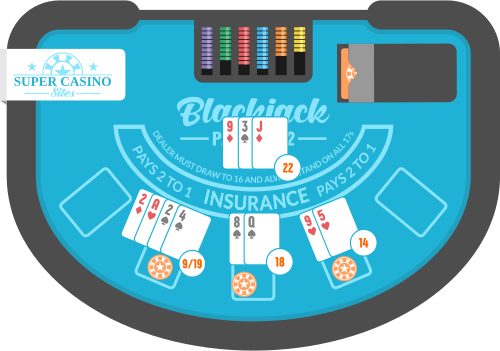 Players are advised to tread cautiously when the dealer exposes cards valued at 2 or 3. The only information you get in this case is that the dealer is certainly not sitting on a pat hand and will have to take at least one hit to reach the obligatory total of 17 or higher.
The probability of the dealer busting with these upcards is relatively high. It stands at around 35% when the dealer shows a 2 and at 37.41% when their upcard is a 3. Accordingly, the player holds an advantage of nearly 10% against the dealer’s 2 and almost 13.5% against their 3. Despite this, the basic strategy for both multiple-deck S17 and H17 games recommends that you stand on hard totals of 13 through 17 when the dealer shows a 2 or a 3.
Standing is the optimal play in this case because the dealer is more likely to exceed 21 with these small cards than to improve their total. If you take a hit, you may break your own hand.
Play More Aggressively against Dealer Upcards 4, 5, and 6
 Basic strategy is built on computer simulations in which millions of hands were played against each of the 13 possible dealer upcards. These simulations established that the weakest upcards for the dealer are 4, 5, and 6. This finding is slightly counterintuitive and gets some players confused, causing them to make incorrect plays at the table.
But as British mathematician James Joseph Sylvester famously claimed, “Mathematics is the music of reason.” The dealer’s probabilities of busting with these upcards are 39.58% for the 4, 41.84% for the 5, and 42.28% for the 6. Why are these cards so harmful to the dealer?
The reason is actually quite simple: each time the dealer exposes one of these values, they are bound to take at least one hit, even if they have a ten-value card in the hole. When the dealer starts with a 6, for example, but their hole card is a Queen, they will be forced to draw another card on their hard 16. Any card valued from 6 to 10 will break their hand and make you an automatic winner (unless you have busted, of course).
The dealer starts their hand with these weak cards only 3 out of 13 times on average, which is why you should always take advantage of these favorable situations. How? By increasing the amount of action you have on the table. Basic strategy tells you to always double down on hard totals 9 through 11 and to split pairs 2-2, 3-3, 6-6, 7-7, 8-8, 9-9, and A-A when the dealer exposes these weak cards.
With soft totals 15 through 17, you should again double against a dealer showing these upcards. If your cards do not allow you to split or double, stand on hard totals of 12 or higher; there is no need to risk busting when the dealer’s chances of doing the same are that high.
Proceed with Caution when the Dealer Exposes 7s or 8s
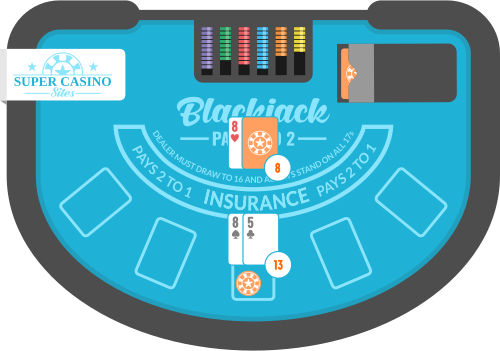 In blackjack, cards with a pip value of 7 or 8 are considered neutral because they favor neither the house nor the player. Be careful when the dealer exposes a 7 or 8, especially if you hold a hand you can easily break with a hit. The dealer’s chances of busting with these cards are lower: 26.19% for the 7 and 24.36% for the 8.
Basic strategy for a six-deck S17 game recommends that you hit hard totals of 12 through 16 against a dealer 7 or 8 and stand on hard totals of 17 or higher. With soft hands, you hit soft 13 through 17. The pairs you can split against a dealer showing a 7 are 2-2, 3-3, 7-7, 8-8, and A-A. Pairs of 9-9 against a dealer 7 call for standing, while pairs 8-8, 9-9, and A-A against a dealer 8 call for a split.
Be Very Careful when the Dealer Shows Cards 9 through Ace
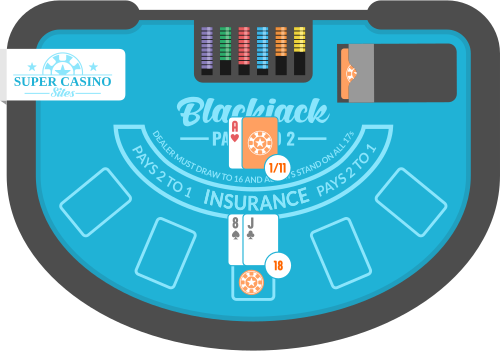 A dealer exposing upcards valued 9 through Ace puts you in a tricky situation. You will lose most of your hands against these upcards because they are advantageous to the dealer and do not allow you to build much of an edge. On average, the dealer will pull these strong upcards 6 out of 13 hands because there are four ten-value cards in addition to the Ace and the 9 (10, Jack, Queen, and King).
It is best to refrain from playing aggressively and instead adopt a more conservative approach when you are at a disadvantage. The probability of the dealer busting with a 9 or a ten-value card drops to around 23%, whereas the chance of them breaking their hand with an Ace in the hole stands at 16.70% in a six-deck S17 game.
In accordance with basic strategy, you are expected to hit hard totals of 12 through 15 against a dealer 9 or Ace in a desperate attempt to outdraw them. The same goes for hard hands of 12 through 14 against a dealer 10. Surrendering is advisable with hard 16 against any of the three strong dealer cards. If surrender is not an option, you hit your hard 16.
Several Important Things to Bear in Mind
 There are many myths about the game of 21, but we tackle those in more detail in a separate article. For now, we shall focus only on the habit of assuming the dealer has a 10 in the hole and give you some handy tips on how to approach certain two-card totals depending on their upcard.
The Incorrect Assumption the Dealer Has a 10 in the Hole
 Many misguided blackjack players recommend that others always assume the dealer’s hole card has a value of 10. However, this assumption is utter rubbish from a probability perspective. This “tactic” accomplishes nothing except increasing the house edge. Some would even go so far as to assure you that basic strategy is based on this assumption. Both statements are untrue, and here is why.
In a full deck, only 16 cards carry a value of ten: 4 Tens, 4 Jacks, 4 Queens, and 4 Kings. The remaining 36 cards have other values, which means the probability of a ten-value card appearing is 16/52, or roughly 30.8%. Accordingly, the odds of one such card appearing are 36 to 16, which means a ten-value card is dealt once every 3.25 hands on average. Why anyone would assume it is dealt more often than this is beyond us.
It goes without saying that basic strategy does not recommend playing by this rule, either. If it did, many of the correct plays listed in the strategy charts would be vastly different. For example, consider a hard 17. If the dealer reveals an 8 and you assume the hole card has a value of ten, you would be advised to hit your hard 17 because otherwise it cannot beat the dealer’s 18. Yet basic strategy tells players to stand on 17 when the dealer’s upcard is an 8.
Remember, basic strategy is not based on information we do not have. The plays it recommends rely only on the cards you can see, and making any other assumption will cost you a small fortune over the long run.
The Rule of 9 and How It Helps You with Some Soft-Doubling Decisions
 The “Rule of 10,” as the above assumption is called, is absolute nonsense, but fortunately we cannot say the same about the “Rule of 9.” The latter can be quite useful when you are struggling with a doubling decision on soft 13 through soft 18. Soft doubles are the hardest part of basic strategy to remember, but the Rule of 9 can help you with them.
This rule uses the dealer’s upcard as a reference point. You should never double when the dealer shows a deuce, because you will lose too often with this play. Doubling on soft 13 through 18 is always a good idea when the dealer’s upcard is a 5 or a 6 because that puts them in the weakest possible spot, and you want to take full advantage of it.
Doubling on soft hands gets trickier when the dealer exposes a 3 or a 4, but not if you abide by the Rule of 9. This is how it works. Add the value of the dealer’s upcard to that of the card next to your Ace (3, 4, 5, 6, or 7). If the result is 9 or higher, you must double your soft hand.
Let’s finish with a couple of quick examples to put the rule into practice. What do you do with A-6 against a dealer 4? You double because the total of 6 and 4 is higher than 9. What about A-4 against a dealer 3? You refrain from doubling and hit your soft 15 instead, since the combined value of the two cards is lower than 9. If you check the strategy chart, you will see you are indeed advised to hit a soft 15 when the dealer’s upcard is a 3.