

 Norway, officially known as the Kingdom of Norway, is a Nordic country with most of its population living in the far southern part of the country near the capital, Oslo. The gambling scene in Norway may seem far too restrictive at first glance, but Norwegians still have plenty of options when they want to place wagers on their favorite casino games or sporting events.
Currently, gambling is legal in Norway, and it is regulated by state-owned companies, including Norsk Tipping AS and Norsk Rikstoto. The former regulates the national lottery, scratch cards, instant games, and some forms of sports betting, while the latter controls horse racing.
The gambling industry in the country is growing rapidly, with a 2018 study showing that 58% of Norwegians reported playing the lottery. In 2019, Norsk Tipping reported revenue of NOK8.16 billion, with profit up 2.8% thanks to online sales. The number of active users for that year reached a record high of 2 million, bringing the full-year turnover to NOK40.27 billion.
Currently, the authorities that regulate the industry are wholly owned by the state. Having a monopoly over the gaming sector is against the regulations imposed by the EU. That said, Norway can get away with that as it is not a member state of the EU but is only associated with it through its membership in the European Economic Area (EEA).
Lottery games made the biggest contribution to Norway’s GGR in 2019, generating NOK5.27 billion for Norsk Tipping. In 2007, all slot halls were banned after numerous cases of companies exploiting a loophole and offering slot machines in various non-gambling facilities. While standard slot machines are banned nationwide, there are still some facilities that offer gaming machines. There are also no land-based casinos located in Norway, which means there is no way to bet on roulette, card games, or other table games.
Gambling Laws in Norway
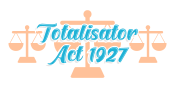
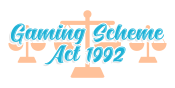
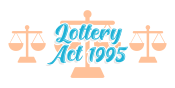
 The gambling industry in Norway is regulated by three key pieces of legislation. These include the Totalisator Act 1927, the Gaming Scheme Act 1992, and the Lottery Act 1995. The legal age for any form of gambling is 18 or older. The only exception is purchasing scratch cards as they can technically be purchased by anyone over the age of 14. However, many lottery vendors refuse to sell scratch cards to individuals who are below the legal gambling age of 18.
According to section 298 of the Norwegian Penal Code 1902, “any person who makes a living by gambling, which is not permitted by a special Act, or by inducement thereto, shall be liable to imprisonment for a term not exceeding one year.” Section 299 states that games in which “gain is the dominant purpose” are classified as gambling.
This law establishes that only licensed games of chance may be offered to Norwegians. Such games are regulated by the state, and unlicensed operators must be penalized.
Many games could fall under the definition of gambling, but to qualify under Norwegian law, a game must meet several criteria. The definition covers both land-based and online games.
The first condition is that individuals must place wagers to participate. Stakes are not necessarily monetary, because there are instances such as the Norwegian lottery Pantelotteriet, where players participate by staking plastic bottles.
The second condition is that players must have a real chance of winning money or other prizes with economic value. Prizes awarded in virtual currency are more difficult to define. In such cases, the game is deemed gambling only if the virtual currency holds economic value.
The third condition is that prizes must result from a random draw, guesswork, or another random outcome that depends on chance. Games of skill do not fall within the scope of gambling.
 Totalisator Act 1927
 Gaming Scheme Act 1992
 Lottery Act 1995
Gaming Authority
 The state-owned operators Norsk Tipping and Norsk Rikstoto are overseen and regulated by the Norwegian Gaming Authority. This authority also issues and suspends licenses, as well as authorizes the provision, distribution, and marketing of gambling activities. The Gaming Authority is also the body that can impose sanctions resulting from breaches of Norway’s gambling laws.
The Gaming Authority may issue licenses only to non-profit organizations. This means that commercial operators cannot apply for gambling licenses. That said, commercial operators authorized by the Gaming Authority can organize gambling activities for non-profit organizations for a fee.
Several types of lotteries do not require a license from the Gaming Authority. These include lotteries by humanitarian and socially beneficial organizations, with the yearly turnover of these lotteries being under NOK200,000. However, if the lottery is organized by a commercial operator, the organization is required to apply for a license.
A license is also unnecessary if a bazaar offers a maximum prize of up to NOK8,000, the maximum allowed stake is NOK5, and the total value of prizes does not exceed NOK40,000. The gambling legislation of Norway also allows private poker games hosted in private homes without a license. All participants must be over the age of 18, the maximum allowed stake per person must be NOK1,000, and there must be fewer than ten players in the game.
Under the Lottery Act, non-profit organizations can obtain a license if they provide several gambling activities. These include post-drawn or pre-drawn lotteries, which are drawn by the Gaming Authority, another public authority, or commercial operators. Poker tournaments, bingo, and pre-drawn scratch cards are also among the activities that require a license. Non-profit organizations must apply for a license when they provide gambling activities on Norwegian ships that sail between the country and foreign harbors. Finally, a license is required if the organization will offer gaming machines.
Online Gambling
 The definition of online gambling in the Norwegian legislation is the same as that of land-based gambling. Only licensed operators are allowed to provide, market, and distribute any form of gambling. Currently, only Norsk Tipping and Norsk Rikstoto are authorized to provide online gambling to Norwegian players.
However, the two state-owned operators that are licensed to offer online gambling do not provide the best odds or the most diverse gaming options to Norwegians. Unfortunately, at the moment, commercial operators cannot apply for online gambling licenses and it seems Norwegian players do not have many options to bet online.
Many offshore operators welcome Norwegian players and will even allow them to use NOK for their deposits and withdrawals. While technically illegal, playing at an offshore online casino is not something that Norwegian players will be prosecuted for. This is why many Norwegians still find plenty of websites where they can enjoy a wide array of games and some of the best odds on sporting events.
In an attempt to prevent Norwegian players from betting on offshore websites, in 2010, the government passed a law that forbids any online gaming payments that are initiated at offshore online casinos and betting sites. Except for the state-owned Norsk Tipping and Norsk Rikstoto, no other operators were allowed to accept credit/debit card payments by Norwegian players. Norwegian banks were required to block any transactions that are related to online gambling at unauthorized offshore websites.
Despite the ban, many unlicensed operators found ways to ensure that Norwegian players would be able to make deposits and withdrawals online and enjoy their favorite casino games or sports bets. Payment solutions like Neteller, Skrill, or other similar methods allow Norwegian players to make payments on offshore gaming websites and place bets online. Even though the government of Norway was trying to eliminate illegal online gambling, it was estimated that Norwegians were still spending around NOK6 billion on gambling at offshore online casinos and sportsbooks.
Applying for a License in Norway
Non-profit and humanitarian or socially beneficial organizations must submit their lottery license applications to the Gaming Authority. Licenses for poker tournaments and lotteries offered by commercial operators on behalf of non-profit organizations are issued after a public application process.
Licenses for lotteries with a turnover of more than NOK200,000 must also be approved by the Gaming Authority. Only humanitarian and socially beneficial organizations registered with the Norwegian Central Coordinating Register for Legal Entities (NCCRLE) are eligible for approval.
Commercial operators that wish to offer lotteries on behalf of licensed organizations must meet several conditions to be authorized by the Gaming Authority. The company must demonstrate a clean criminal record, be registered with the NCCRLE, and be solvent. The authorization and licensing process handled by the Gaming Authority usually takes about three months.
 Cost of Licenses
 Taxes on Gambling in Norwegia
Plans for Revision of Gambling Laws in Norway
 The Norwegian government has begun to realize that the current full-monopoly model of regulating the gambling business leads to significant losses in tax revenue. If Norway legalizes and regulates online gambling within the country, numerous Norwegians will simply choose to bet at local licensed operators rather than resorting to offshore illegal gambling.
The country’s main regulator, Lotteritilsynet, believes that better regulation of the gambling sector could decrease illegal wagering in Norway and lead to significant growth in Gross Gaming Revenue (GGR).
Authorities in Norway have proposed some amendments to the gambling legislation to ensure a better gambling environment and a properly regulated industry. Since there are different forms of gambling, they should be regulated using different approaches and control measures. According to government officials, it is not possible to regulate offline and online gambling by using the same legislation. Mixing the two types of gambling will only lead to further confusion and many will take advantage of these circumstances.
The decision to introduce changes to the gambling law was also supported by the fact that the current three acts that control the industry are outdated and cannot be properly applied to the modern gambling environment in Norway. Only time will tell whether there will be any amendments to the gambling law in Norway. Even if that happens, it does not guarantee that the state-monopoly system of regulation will soon be replaced by a new model of regulating the gambling sector in the country.