
 As in any other jurisdiction, Canada has its own set of rules that govern gambling within its territory. The country has a complex gambling landscape, as regulations and legislation vary by province. Canadian residents can gamble online without fear of prosecution.
Much of this complexity stems from the country’s political system and territorial structure. The Great White North, as Canada is also known, consists of ten provinces (Ontario, Quebec, Nova Scotia, New Brunswick, Manitoba, British Columbia, Newfoundland and Labrador, Prince Edward Island, Saskatchewan, and Alberta) and three territories to the north (Yukon, the Northwest Territories, and Nunavut).
Each of these territorial divisions has its own laws that regulate or prohibit different forms of gambling. An exception is made for horse racing, which is regulated at the federal level. Some provinces, such as Ontario, British Columbia, Manitoba, and Quebec, have already introduced certain forms of regulated online gambling.
Similar to the United States, Canada is home to many different Indigenous tribes, many of which have chosen to become involved in the gaming industry. It is not unheard of for such tribes to operate casinos on their reservations without provincial authorization.
Canada is also home to one of the largest online gambling regulators in the world, the Kahnawake Gaming Commission. Let’s take a closer look at how Canada’s gambling sector is regulated at both the federal and provincial levels.
Federal Level Regulations under the Criminal Code of Canada
 Let us start by clarifying that there is no distinction between the regulation of virtual and land-based gambling in Canada; in other words, individual rules for online gaming are lacking. Gambling activities in the country are governed at the federal level under the Criminal Code of Canada, specifically in Sections 201 through 206.
This federal statute declares that, by default, all forms of gaming, wagering, and lotteries are illegal in the country. Section 204 of the Criminal Code makes an exception for pari-mutuel horse race betting, which is regulated by the Canadian Pari-Mutuel Agency, a unit of the federal Department of Agriculture.
According to Section 201 of the Code, “every person who keeps a common gaming or betting house is guilty of an indictable offense and liable to imprisonment for […] no more than two years“. Offenders can also be punished on summary conviction. Mere participation is illegal as well.
Section 202 of the Criminal Code tackles sports betting, bookmaking, and pool-selling. It declares that any individual who knowingly allows a place under their control to be used for the recording or registering of wagers or for selling pools commits an offense.
The same applies to advertising such activities, placing bets on behalf of another person, or inducing others to take part in them. Section 204 (c) of the Code makes an exception for pari-mutuel wagers on running, trotting, and pacing horse races. Pari-mutuel wagering on horses is governed by the regulations of the Minister of Agriculture and Agri-Food.
Another “serious offense” is outlined in the Code’s Section 206, which has to do with illegal lottery tickets and games of chance. Section 207 details what constitutes the “permitted lotteries“, namely those operated by the governments of individual provinces and by licensed charitable and religious organizations.
Activities That Constitute Gambling according to the Criminal Code
 According to the Criminal Code, the category of gambling activities comprises bingo, casino games, lotteries, slot machines, poker, video lottery terminals (VLTs), sports betting, and other card games. The Code also prohibits some activities that are not necessarily seen as gambling by laypeople.
However, an individual who hosts or offers competitions that do not require payment to enter is not in violation of federal laws. There are also subtle distinctions between skill games, games of pure chance, and games that combine both skill and chance.
Skill games, where the element of chance is entirely absent, are not considered illegal under Section 206 of the Criminal Code. They can be offered legally without obtaining permission from the authorities.
Canadian federal laws do not recognize the concept of skill as a dominant factor. Thus, poker is still considered an “illegal lottery”. Skill is a major factor in the game, but there is still an element of chance that results from the random dealing of the cards.
Gambling Regulations in Canada’s Individual Provinces
Although many forms of gambling are listed as illegal under the Criminal Code, the federal government granted individual provinces exclusive authority to enact their own gambling laws and regulations in 1985. The bottom line is that gambling is illegal unless it is conducted and regulated by provincial governments. They can organize, control, and carry out gambling within their territory under Section 207 of the Code.
This further adds to the confusion because gambling laws, regulatory bodies, registration procedures, and permitted activities differ from one province to another. Below, we briefly cover the gambling rules for each province and territory in Canada.
 Alberta Regulations
 British Columbia Regulations
 Manitoba Regulations
 Ontario Regulations
 Quebec Regulations
 Nova Scotia Regulations
 Saskatchewan Regulations
 New Brunswick Regulations
 Prince Edward Island Regulations
 Newfoundland and Labrador Regulations
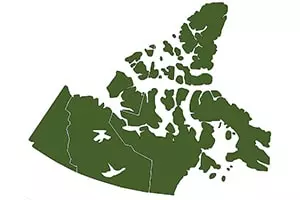 Gambling in Canada’s Three Territories
Gambling Advertising, Taxes, and Consumer Protection
 Each provincial government in Canada may exercise individual control over the selection of available gambling products, the places where those products are legally offered, and the way they are marketed.
Advertising rules vary from one province to another. Ontario, for example, prohibits certain advertisements under Section 8 of Bill 152, which states that “No person shall advertise an Internet gaming site that is operated contrary to the Criminal Code“.
As for taxation, recreational players in most provinces are not taxed on their gaming profits unless they fall into the category of professional gamblers.
All provincial lottery corporations address social responsibility in their regulatory policies. Management staff and front-line employees must undergo mandatory training on responsible gambling and inform their players how to keep their gaming activities in check.
Self-exclusion programs are available to customers who are already in trouble. The self-exclusion program in the province of Ontario, for instance, implements facial-recognition technology to detect problem gamblers in land-based venues.
Types of Regulated Online Gambling Operations in Canada
There are no private land-based or online casinos in the Great White North. Licenses cannot be granted to private online gambling operators. Instead, such companies can enter the local market by cooperating with government-owned entities, which exist in all Canadian provinces in the form of lottery corporations and gambling venues.
Private companies assume the role of software suppliers and provide the technical support needed to carry out gambling activities. They must first enter into agreements with the provincial lottery corporations before they begin to operate.
In turn, provincial governments and regulators conduct mandatory evaluations of these operators to ensure they meet the criteria for integrity and reliability. The most prominent examples of gambling sites regulated from within Canada include SportSelect, the Atlantic Lottery, PlayOLG, and PlayNow. Provincial regulators maintain registries where players can verify authorized service providers.
 Legality of Offshore Gambling Operators
 Operators Overseen by the Kahnawake Gambling Commission